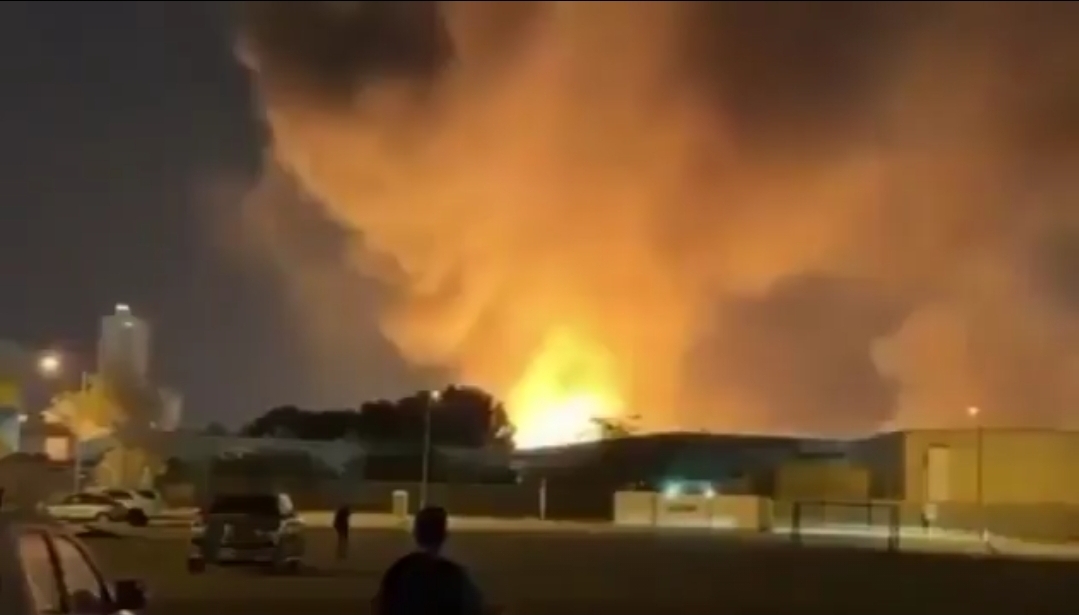
The escalating conflict involving Saudi Arabia and Yemen's Houthi movement has entered a more consequential phase following a missile strike on the headquarters complex of Saudi Aramco, the world's largest oil-producing company.
The attack, which occurred on October 13 in Dhahran, eastern Saudi Arabia, represents a significant escalation in the targeting of strategically important Saudi infrastructure.
According to reports by Reuters and the Associated Press, a ballistic missile struck an administrative building within the Aramco headquarters complex, damaging its upper floors, including offices used by senior executives. The office of Aramco's Chief Executive Officer was reportedly among the affected areas.
The incident resulted in a fire that spread across several floors of the building. Saudi authorities reported no fatalities or injuries from the headquarters attack.
Although the Saudi Energy Ministry initially described the damage as limited, sources familiar with the incident told Reuters that the fire affected multiple floors, with substantial damage to parts of the executive office building.
Importantly, the headquarters complex is not an ordinary corporate office. It houses an operations centre responsible for overseeing critical components of Aramco's extensive energy infrastructure, including oil fields, pipelines, refineries and export terminals.
This makes the attack particularly significant.
The incident also demonstrates how the boundaries between conventional military targets and critical economic infrastructure are becoming increasingly blurred in the expanding Middle Eastern conflict.
While the Houthis have repeatedly threatened Saudi energy facilities, an attack reaching the headquarters of a company responsible for a substantial share of global oil production sends a powerful geopolitical message.
Saudi Arabia has since faced additional security challenges, including attacks on airports and energy infrastructure, further intensifying concerns about the country's economic and strategic security.
The immediate concern is no longer limited to the physical damage sustained by individual buildings. It is increasingly about the vulnerability of the infrastructure that supports international energy markets.
BEYOND THE MISSILE: HOW THE SAUDI–HOUTHI CONFLICT COULD SHAKE THE GLOBAL ECONOMY
By Civic Watch Media | Global Affairs & Economic Intelligence Desk
The missile strike on Saudi Aramco's headquarters deserves attention beyond its immediate military implications.
To understand its potential consequences, one must understand the position Saudi Arabia occupies in the global economic system.
Saudi Arabia is not simply another oil-producing country. It is one of the most influential players in the international energy market, and its national oil company, Aramco, occupies a central position in global petroleum production and supply.
Consequently, any sustained military campaign against Saudi Arabia's strategic energy infrastructure could produce economic consequences far beyond the Middle East.
Here are five major areas of concern.
1. GLOBAL OIL PRICES AND ENERGY SECURITY
The first and most immediate concern is the international oil market.
Saudi Arabia is one of the world's largest oil producers. Its ability to maintain consistent production and exports is important to global energy stability.
An attack on Aramco's headquarters does not automatically mean that oil production has stopped. Indeed, reports indicated that operations at the headquarters complex continued despite the damage.
However, the strategic concern is the possibility of subsequent attacks on production facilities, processing plants, pipelines, storage infrastructure and export terminals.
If the conflict begins to affect actual production or export capacity, international oil prices could experience significant upward pressure.
For countries heavily dependent on imported petroleum, this could translate into:
- Higher fuel prices.
- Increased transportation costs.
- More expensive electricity generation.
- Higher manufacturing and distribution expenses.
- Renewed inflationary pressure.
The important distinction is between an attack on corporate infrastructure and an actual disruption of oil supply. The former has already happened; the latter remains a significant risk.
2. THE STRAIT OF HORMUZ AND BAB EL-MANDEB: THE WORLD'S ECONOMIC PRESSURE POINTS
Perhaps the greatest danger lies beyond Saudi Arabia's borders.
Two maritime corridors are particularly important to this conflict:
- The Strait of Hormuz.
- The Bab el-Mandeb Strait.
The Strait of Hormuz connects the Persian Gulf to international waters through which substantial quantities of the world's petroleum and liquefied natural gas move.
Bab el-Mandeb connects the Red Sea with the Gulf of Aden and the wider Indian Ocean, making it an essential passage for international shipping between Europe and Asia.
These waterways are not merely geographical features. They are strategic economic corridors.
Any sustained military escalation threatening their accessibility could force commercial vessels to change routes, increasing shipping distances, insurance premiums, fuel consumption and delivery times.
The consequences could affect:
- International oil and gas shipments.
- European and Asian manufacturing supply chains.
- Container shipping.
- Food and agricultural trade.
- International trade costs.
A prolonged disruption could turn a regional military confrontation into a global commercial crisis.
The strongest angle for Civic Watch Media is to move beyond the immediate damage to Saudi Arabia and examine how this escalation could become an economic and geopolitical crisis for Europe and the United States — while certain countries, political interests and defence industries stand to benefit from a prolonged war.
Here is a publication-ready analytical section:
THE GLOBAL PRICE OF ESCALATION: HOW EUROPE AND AMERICA COULD PAY FOR A WAR OTHERS PROFIT FROM
The consequences of the escalating Middle East conflict will not remain confined to the Arabian Peninsula. Europe and the United States could become some of its biggest economic casualties, even without being directly struck by a missile.
The reported Houthi strike on the Saudi Aramco headquarters in Dhahran represents more than another military development. It exposes the vulnerability of the energy infrastructure upon which international markets, industrial production and global economic stability depend.
For Europe, the implications are particularly serious.
European economies remain heavily exposed to fluctuations in international energy prices. Any sustained disruption to Gulf oil production, export infrastructure or shipping routes could translate into higher fuel prices, increased transportation costs, expensive electricity and renewed inflationary pressure.
For ordinary Europeans, this could mean more expensive heating, food, manufacturing and transportation. Businesses would face higher operating costs, while households would carry another financial burden from a conflict thousands of kilometres away.
America is not insulated either.
Although the United States remains a major energy producer, global oil prices are internationally interconnected. An escalation involving Saudi Arabia, Iran and strategically important shipping routes could push American fuel prices higher, increase inflationary pressure and complicate domestic economic policy.
The consequences could extend into American politics, particularly as rising living costs become an increasingly sensitive issue for voters.
WHO REALLY BENEFITS WHEN WARS REFUSE TO END?
There is another dimension that deserves serious attention.
Wars do not produce equal consequences for everyone.
While ordinary citizens suffer inflation, displacement, insecurity and economic uncertainty, certain interests can benefit financially and strategically from prolonged instability.
The international defence industry, for example, can experience increased demand for missiles, interception systems, military aircraft, surveillance technology and ammunition as governments rush to strengthen their security capabilities.
Energy exporters outside the immediate conflict zone may also benefit from elevated oil prices.
Meanwhile, geopolitical actors can use prolonged instability to weaken competitors, expand regional influence, increase dependence on military alliances and secure strategic advantages.
This creates an uncomfortable question:
When a war continues to generate strategic and financial advantages for powerful interests, who has the strongest incentive
THE GLOBAL PRICE OF ESCALATION: HOW EUROPE AND AMERICA COULD PAY FOR A WAR OTHERS PROFIT FROM
The consequences of the escalating Middle East conflict will not remain confined to the Arabian Peninsula. Europe and the United States could become some of its biggest economic casualties, even without being directly struck by a missile.
The reported Houthi strike on the Saudi Aramco headquarters in Dhahran represents more than another military development. It exposes the vulnerability of the energy infrastructure upon which international markets, industrial production and global economic stability depend.
For Europe, the implications are particularly serious.
European economies remain heavily exposed to fluctuations in international energy prices. Any sustained disruption to Gulf oil production, export infrastructure or shipping routes could translate into higher fuel prices, increased transportation costs, expensive electricity and renewed inflationary pressure.
For ordinary Europeans, this could mean more expensive heating, food, manufacturing and transportation. Businesses would face higher operating costs, while households would carry another financial burden from a conflict thousands of kilometres away.
America is not insulated either.
Although the United States remains a major energy producer, global oil prices are internationally interconnected. An escalation involving Saudi Arabia, Iran and strategically important shipping routes could push American fuel prices higher, increase inflationary pressure and complicate domestic economic policy.
The consequences could extend into American politics, particularly as rising living costs become an increasingly sensitive issue for voters.
WHO REALLY BENEFITS WHEN WARS REFUSE TO END?
There is another dimension that deserves serious attention.
Wars do not produce equal consequences for everyone.
While ordinary citizens suffer inflation, displacement, insecurity and economic uncertainty, certain interests can benefit financially and strategically from prolonged instability.
The international defence industry, for example, can experience increased demand for missiles, interception systems, military aircraft, surveillance technology and ammunition as governments rush to strengthen their security capabilities.
Energy exporters outside the immediate conflict zone may also benefit from elevated oil prices.
Meanwhile, geopolitical actors can use prolonged instability to weaken competitors, expand regional influence, increase dependence on military alliances and secure strategic advantages.
This creates an uncomfortable question:
When a war continues to generate strategic and financial advantages for powerful interests, who has the strongest incentive to push for its continuation, and who has the greatest responsibility to pursue peace?
It would be premature to conclude that every country supporting military action is deliberately prolonging the conflict for financial gain. However, the economic incentives surrounding warfare are real and deserve scrutiny.
THE DANGEROUS POLITICS OF PROXY CONFLICTS
The greatest danger is that regional conflicts increasingly become extensions of larger geopolitical rivalries.
Countries may supply weapons, intelligence, financing, diplomatic protection or military assistance to competing parties without necessarily committing their own populations to the full consequences of the battlefield.
Yet the economic consequences eventually travel beyond the original combatants.
A missile targeting an energy facility in Saudi Arabia can influence international oil prices. Disruption around the Red Sea can affect European shipping costs. Instability around the Strait of Hormuz can send shockwaves through international markets.
In this interconnected world, geographical distance offers little economic protection.
THE REAL WINNERS AND LOSERS
If the conflict continues to expand, the distinction between those who profit from war and those who pay for it could become increasingly visible.
- European households: Higher energy, transportation and consumer prices.
- American consumers: Potentially higher petrol prices and renewed inflationary pressure.
- Developing economies: More expensive fuel imports, weaker currencies and increased cost-of-living pressures.
- Defence contractors: Potentially increased demand for military equipment and replenishment.
- Alternative energy exporters: Potential commercial advantages from supply disruptions.
- Regional populations: Greater insecurity, economic destruction and humanitarian suffering.
The uncomfortable reality is that the people who experience the greatest consequences of war are rarely the people making the decisions that determine whether it continues.
The world must therefore look beyond who is winning the military confrontation and begin asking who is benefiting from its continuation.
Because when geopolitical competition becomes more profitable than diplomatic resolution, peace becomes increasingly difficult to achieve.
The question is no longer simply how far this conflict can spread. It is how much of the global economy must suffer before the powerful decide that the price of escalation has become too high.
CIVIC WATCH MEDIA
Watching Power. Questioning Narratives. Reporting Reality.
Note: Reuters reported that the Aramco headquarters complex attacked on October 13 was in Dhahran, in Saudi Arabia's Eastern Province, near Dammam. Reuters reported damage to an office tower's top three floors, while Saudi authorities described a limited fire and no casualties at that site.
The wider economic concerns are not merely theoretical: the Financial Times reported that Brent crude reached $110 amid the October escalation.
This framing gives Civic Watch Media a stronger geopolitical analysis rather than simply reproducing the military headlines.
3. AFRICA COULD ALSO FEEL THE CONSEQUENCES
For African economies, the conflict presents a complicated economic situation.
Although some African countries produce crude oil, many remain vulnerable to international petroleum price movements.
Nigeria, for example, could experience both positive and negative consequences.
Potential benefits:
Higher international crude prices could increase government revenue and foreign exchange earnings, provided Nigeria maintains sufficient production and export capacity.
Potential disadvantages:
Higher international petroleum prices could increase Nigeria domestic transportation expenses, food distribution costs, manufacturing expenses and general living costs.
Even where domestic refining capacity reduces dependence on imported petroleum products, international crude prices and other energy-market pressures can still influence Nigeria domestic costs.
4. INTERNATIONAL INVESTMENT AND FINANCIAL MARKET INSTABILITY
War creates uncertainty, and uncertainty is expensive.
International investors generally prefer environments where businesses, infrastructure and investments can operate without significant geopolitical risks.
Saudi Arabia has invested heavily in economic diversification, tourism, infrastructure, technology and international partnerships through its Vision 2030 programme.
However, sustained insecurity could undermine investor confidence.
Businesses may reconsider expansion plans, international conferences could be postponed, tourism could decline and financial institutions could demand higher risk premiums.
The consequences are already becoming visible in the wider Gulf economy.
Reuters has reported that the escalating regional crisis has placed additional pressure on Gulf economic recovery prospects, tourism, aviation and foreign investment.
The implications extend beyond Saudi Arabia to the United Arab Emirates, Qatar and other economies whose development strategies depend heavily on international capital and regional stability.
5. THE RISK OF A MUCH WIDER REGIONAL WAR
Perhaps the most dangerous dimension is the possibility of further military escalation.
The Houthi movement has demonstrated an ability to threaten strategic infrastructure beyond Yemen.
Saudi Arabia, meanwhile, faces pressure to defend its territory, protect its economic assets and maintain its regional influence.
The involvement of other regional and international powers could make the situation considerably more complicated.
The conflict also exists within the wider context of tensions involving Iran, the United States and other Middle Eastern actors.
If additional countries become directly involved, the consequences could extend into international shipping, energy security, financial markets and diplomatic relations.
The danger is that military retaliation could create a cycle of escalation in which neither side can easily withdraw without political and strategic consequences.
This is why diplomatic intervention remains essential.
CIVIC WATCH MEDIA: THE BIGGER PICTURE
THE WORLD'S ECONOMY IS MORE CONNECTED TO WAR THAN MANY PEOPLE REALISE.
There is an important lesson in the attack on Saudi Aramco's headquarters.
Modern warfare is no longer measured exclusively by territorial occupation, military casualties or the destruction of conventional military installations.
It increasingly involves the strategic vulnerability of the infrastructure that sustains national economies.
An oil company headquarters, an international airport, a shipping corridor, an electricity network or a major telecommunications facility can have implications extending far beyond the country in which it is located.
The Aramco incident illustrates this reality.
However, it is important not to mistake a symbolic and strategically significant attack for the collapse of Saudi oil production. The headquarters attack caused substantial building damage, but there has been no established evidence that it independently brought Aramco's overall production operations to a halt.
The real danger lies in what could happen next.
If attacks expand from administrative buildings to actual production and export infrastructure, the consequences could become considerably more severe.
For developing economies, particularly those already struggling with inflation and economic instability, the effects could be especially painful.
The international community therefore has a responsibility to prevent further escalation and protect critical civilian and economic infrastructure.
The central question is no longer simply who is winning the war in Yemen. It is how much of the global economy could eventually pay the price for a conflict that continues to expand.
CIVIC WATCH MEDIA
Watching Power. Questioning Narratives. Reporting Reality.
— Civic Watch Media | Monitoring Global Developments, Understanding Their Local Consequences.