India's capital markets are undergoing a structural transformation. While retail investors chase headline-grabbing unicorns and established conglomerates, sophisticated capital is quietly accumulating positions in a different class of enterprises entirely—proxy companies. These specialized enablers, infrastructure providers, and component manufacturers represent the most compelling risk-adjusted opportunity in emerging market equities today.
Proxy investing is not merely a tactical allocation. It is a fundamental reconceptualization of thematic exposure: rather than accepting the volatility, capital intensity, and competitive uncertainty of end-market players, investors can capture sectoral growth through the indispensable suppliers and infrastructure layers that underpin entire industries.
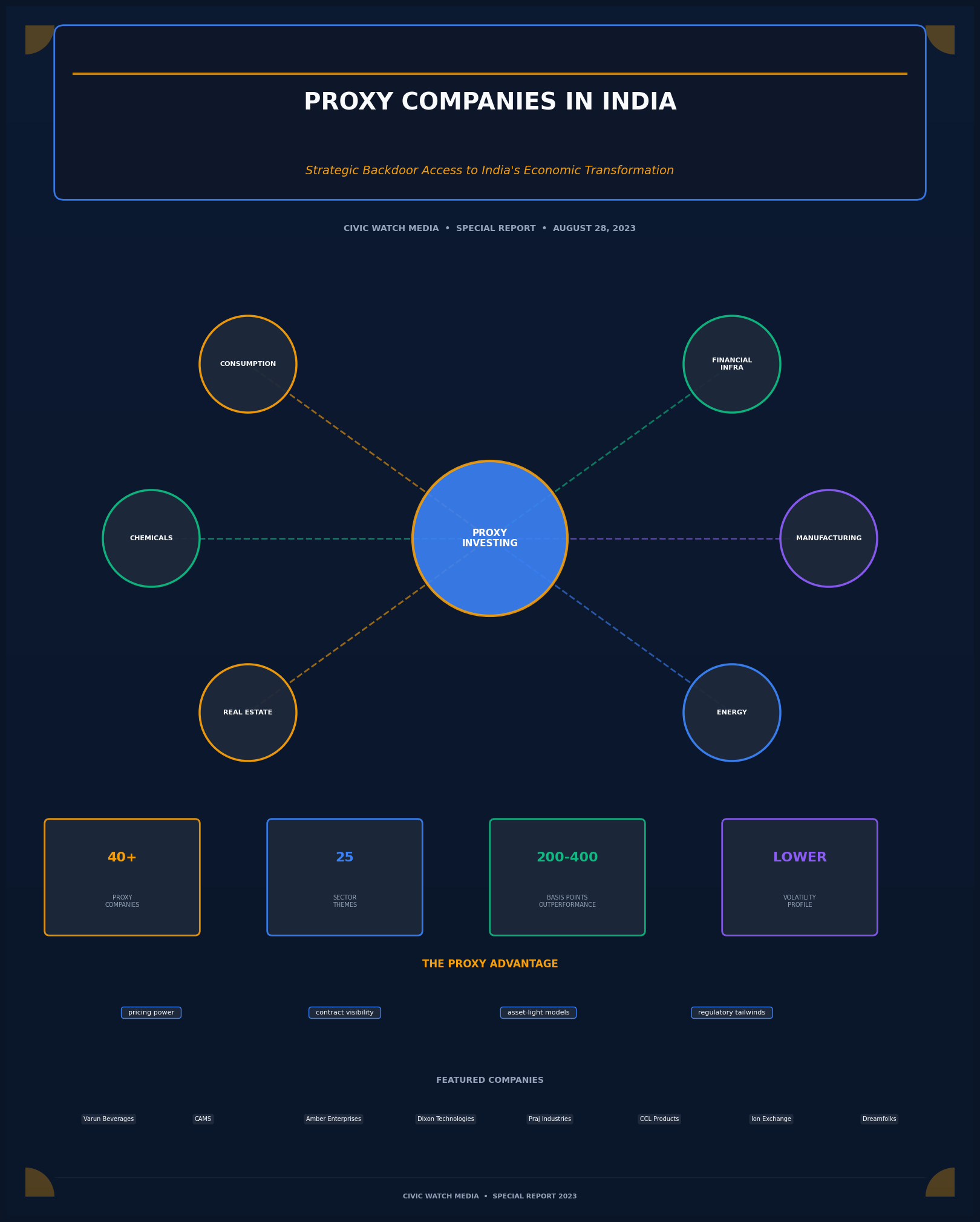
This report presents a comprehensive sectoral analysis of India's proxy investment landscape, identifying 40+ specialized companies across 25 distinct economic themes. Our methodology prioritizes businesses with pricing power, contract visibility, asset-light models, and regulatory tailwinds—attributes that historically generate superior shareholder returns through market cycles.
I. The Proxy Investment Thesis
Defining the Opportunity Set
A proxy company is defined by three characteristics:
1. Indispensability: The product or service is essential to the operations of multiple players within a target sector
2. Insulation: Business model exhibits lower correlation to end-market volatility and commodity cycles
3. Scalability: Revenue expands with sectoral growth without proportional capital deployment
The strategic appeal is quantifiable. Historical analysis of Indian mid-cap industrials demonstrates that component manufacturers and infrastructure enablers have delivered 200-400 basis points of annual outperformance relative to their end-market customers over the past decade, with materially lower drawdowns during correction phases.
II. Sectoral Analysis: Proxy Plays by Economic Theme
A. Consumer Economy Infrastructure
Varun Beverages Ltd operates as PepsiCo's largest franchisee outside the United States, commanding exclusive bottling and distribution rights across India and select emerging markets. The franchise model eliminates brand-building costs and R&D expenditure while capturing volume growth in India's under-penetrated non-alcoholic beverage market. The company's capital efficiency metrics—particularly working capital turns and asset intensity—compare favorably to global beverage peers.
Mrs Bectors Food Specialities Ltd has established dominant positioning in premium bakery and biscuit manufacturing. Beyond its owned brands, the company serves as a critical supplier to quick-service restaurant chains and modern retail formats. This dual revenue stream—branded and contract manufacturing—provides earnings stability while maintaining margin expansion potential.
Hindustan Foods Ltd represents the pure-play contract manufacturing thesis. As FMCG majors accelerate outsourcing to asset-light models, Hindustan Foods captures volume growth across multiple product categories without concentration risk to any single brand's market share fluctuations. The company's pan-India manufacturing footprint positions it as the infrastructure layer for India's consumption story.
CCL Products (India) Ltd is the world's largest private-label instant coffee manufacturer, supplying global beverage brands while remaining invisible to end consumers. This positioning eliminates marketing expenditure and price competition in retail channels. The company's freeze-dried coffee capacity expansion directly correlates with global coffee consumption trends, particularly in Asian markets exhibiting premiumization.
B. Financial Services Infrastructure
PB Fintech Ltd (PolicyBazaar) has constructed India's dominant digital insurance distribution platform. The asset-light marketplace model generates commission revenues without balance sheet risk from underwriting operations. As insurance penetration in India advances toward emerging market averages, PolicyBazaar's data advantages and scale economics create defensive moats around distribution economics.
Computer Age Management Services Ltd (CAMS) operates as the registrar and transfer agent for India's mutual fund industry. The business model exhibits extraordinary annuity characteristics: CAMS collects per-transaction and maintenance fees regardless of fund performance or asset class preferences. With systematic investment plan (SIP) growth driving transaction volumes, CAMS represents pure-play exposure to India's formalization of household savings.
Central Depository Services (India) Ltd and Angel One Ltd capture complementary aspects of securities market infrastructure. CDSL benefits from dematerialization trends and equity account proliferation, while Angel One's discount brokerage model scales with retail participation in derivatives and cash markets. Both businesses demonstrate operating leverage as fixed technology costs amortize over expanding transaction volumes.
Multi Commodity Exchange of India Ltd provides essential clearing and settlement infrastructure for commodity derivatives. Regulatory mandates for hedging by commercial participants, combined with speculative interest, generate sustainable transaction-based revenues insulated from commodity price directionality.
C. Industrial Manufacturing & Precision Components
Harsha Engineers International Ltd has achieved global leadership in precision bearing cages, a critical component in automotive, industrial, and renewable energy applications. The specialized manufacturing expertise creates customer switching costs and pricing power. Global OEM qualification processes—which typically require 18-24 month validation cycles—protect market position while the company's Indian manufacturing base offers cost advantages.
Elecon Engineering Company Ltd supplies material handling systems and industrial gear solutions, with particular strength in Indian defense and warship programs. The strategic nature of defense procurement provides revenue visibility, while commercial industrial applications diversify the order book. Recent capacity expansion targets export markets in Southeast Asia and the Middle East.
Sundram Fasteners Ltd operates as a precision component supplier across multiple high-growth verticals: automotive original equipment, wind energy installations, and commercial vehicle aftermarket. This sectoral diversification reduces cyclicality while maintaining manufacturing expertise concentration.
Craftsman Automation Ltd and Sterling Tools Ltd provide engineered assemblies and fastening systems for commercial vehicle manufacturers. The transition to Bharat Stage VI emission standards and subsequent technology upgrades in the CV sector drive content-per-vehicle increases, directly benefiting component suppliers with established OEM relationships.
ZF Commercial Vehicle Control System India Ltd represents advanced braking and vehicle control technology for the commercial vehicle segment. As safety regulations tighten and autonomous driving technologies penetrate commercial applications, ZF's electronic control systems capture increasing value share within vehicle bill-of-materials.
Ramkrishna Forgings Ltd and Bharat Forge Ltd operate at the critical intersection of metallurgical expertise and precision engineering. Ramkrishna's recent capacity expansion targets aerospace and defense applications—segments commanding 40-60% gross margin premiums over automotive forgings. Bharat Forge's global footprint and diversification into aluminum components for electric vehicles position the company for structural growth in lightweighting trends.
D. Energy Transition & Power Infrastructure
Skipper Ltd manufactures transmission towers and poles, the physical infrastructure for grid expansion and renewable energy integration. India's target of 500 GW non-fossil fuel capacity by 2030 requires unprecedented transmission infrastructure investment. Skipper's integrated manufacturing—from steel processing to galvanization—ensures margin capture across the value chain.
TD Power Systems Ltd produces turbine generators for thermal, hydro, and renewable power applications. The company's technology licensing agreements with global OEMs provide access to advanced designs while maintaining domestic manufacturing cost structures.
Praj Industries Ltd has established global leadership in ethanol plant engineering and execution. India's ethanol blending program—targeting 20% blending by 2025—requires substantial capacity expansion across sugar mills and grain-based distilleries. Praj's process technology and project execution capabilities create sustainable competitive positioning as biofuel mandates expand globally.
Ion Exchange Ltd appears across multiple thematic exposures: water treatment for power plants, ultrapure water systems for semiconductor fabrication, and electrolyzer technologies for green hydrogen production. This convergence of applications—each representing multi-year growth vectors—creates portfolio optionality within a single industrial holding.
Tata Power Company Ltd is repositioning from conventional generation to renewable energy and electric vehicle charging infrastructure. The EV charging network—currently in early deployment phase—represents a regulated utility-style revenue stream with decades of growth visibility as electric mobility penetrates Indian markets.
E. Climate Control & Electronics Manufacturing
Amber Enterprises India Ltd is India's largest OEM for air conditioning systems, supplying components and complete units to major consumer brands. The structural driver of AC penetration—currently below 10% of households despite tropical climate—supports multi-year volume growth. The OEM model eliminates brand marketing costs while maintaining pricing power through technical specifications and manufacturing scale.
Dixon Technologies (India) Ltd has emerged as India's premier electronics manufacturing services provider, producing mobile phones, lighting products, and consumer durables for domestic and global brands. Government production-linked incentive (PLI) schemes specifically target electronics manufacturing, providing Dixon with margin support and capacity expansion financing. The company's operational execution—scaling from under 100 million to over 1 billion revenue in five years—demonstrates management capability.
F. Transportation & Mobility Components
Rajratan Global Wire Ltd manufactures bead wire, a critical steel component in tyre manufacturing. The company supplies all major domestic and global tyre brands, creating revenue diversification across OEM and replacement market cycles. Recent capacity expansion in Thailand positions Rajratan to serve Southeast Asian tyre manufacturing hubs.
NOCIL Ltd produces rubber chemicals essential for tyre vulcanization and performance characteristics. As tyre complexity increases with electric vehicle weight requirements and fuel efficiency standards, chemical content per tyre expands, directly benefiting specialized suppliers.
Sona BLW Precision Forgings Ltd has pivoted from traditional automotive components to electric vehicle transmission systems. The company's differential gear and reduction drive technologies are specified by global EV platforms, creating export revenue streams and technology validation.
G. Chemicals & Materials Science
Alkyl Amines Chemicals Ltd, Navin Fluorine International Ltd, and Clean Science & Technology Ltd represent India's emergence as a global specialty chemicals manufacturing hub. Each company occupies distinct chemical technology niches—amines chemistry, fluorination, and catalytic processes respectively—that serve pharmaceutical, agrochemical, and industrial applications.
The common investment thesis: these companies supply critical intermediates to formulated product manufacturers without exposure to end-product pricing or regulatory approval cycles. China's environmental compliance costs and supply chain reconfiguration create sustainable market share opportunities for Indian competitors.
Deepak Nitrite Ltd has achieved backward integration into phenol manufacturing, a fundamental chemical intermediate with applications across pharmaceuticals, agrochemicals, and performance materials. The company's phenol-acetone complex represents one of India's largest chemical process installations, creating domestic supply security for downstream industries.
Carborundum Universal Ltd manufactures abrasives, ceramics, and electro-minerals for industrial applications. The company's technical ceramics division serves semiconductor fabrication equipment—a high-growth, high-margin segment with significant import substitution potential.
Apcotex Industries Ltd produces synthetic latex for carpet backing, paper coatings, and rubber construction applications. The company's product portfolio captures growth in both industrial applications and consumer flooring trends.
Sudarshan Chemical Industries Ltd is India's largest pigments manufacturer, supplying color solutions for paints, plastics, and printing applications. Pigment chemistry requires significant R&D investment and regulatory compliance, creating barriers to entry that protect established players.
H. Real Estate & Construction Ecosystem
The real estate sector presents particularly compelling proxy opportunities, as construction activity requires extensive specialized materials and components beyond the headline cement and steel names.
APL Apollo Tubes Ltd manufactures structural steel tubes for construction, infrastructure, and industrial applications. The company's branded products command specification premiums in architectural applications, while volume production serves industrial and infrastructure segments. Real estate construction, industrial capex, and government infrastructure each contribute to demand diversification.
RHI Magnesita India Ltd supplies refractory materials—heat-resistant linings essential for steel and cement manufacturing. As India's steel production capacity expands to meet domestic and export demand, refractory consumption grows proportionally. The technical nature of refractory engineering creates customer stickiness and pricing power.
Asian Paints Ltd, while a recognized consumer brand, functions as a real estate proxy through its decorative paints segment, which correlates with housing completion cycles. The company's distribution density and brand equity generate superior pricing power and working capital efficiency relative to global peers.
Tata Steel Ltd provides structural steel for construction and infrastructure applications. The integrated steel model—spanning iron ore mining to finished products—ensures margin capture across commodity cycles.
Polycab India Ltd manufactures wires and cables for building construction, infrastructure, and industrial applications. Real estate electrical installation represents a significant revenue segment, with infrastructure and renewable energy providing growth diversification.
Kajaria Ceramics Ltd is India's largest ceramic tile manufacturer. The organized sector's market share gains from unorganized competitors, combined with premium product mix expansion, support margin expansion despite real estate cyclicality.
Pidilite Industries Ltd dominates adhesives and construction chemicals through the Fevicol brand franchise. The company's product portfolio spans professional construction applications and retail DIY segments, creating multiple demand channels.
Astral Ltd has established market leadership in plumbing pipes and fittings, with recent expansion into adhesives and construction chemicals. The company's distribution network and brand recognition in the plumbing contractor channel create sustainable competitive positioning.
Ambuja Cements Ltd and Century Plyboards (India) Ltd provide fundamental building materials—cement and plywood respectively—with brand premiums in residential construction. Both companies benefit from urbanization trends and housing formalization.
Cera Sanitaryware Ltd manufactures sanitaryware and faucet products for residential and commercial construction. The company's brand positioning and distribution reach capture value in India's bathroom upgrade cycle.
I. Industrial Capital Expenditure & Infrastructure
Steelcast Ltd, KEI Industries Ltd, Pix Transmission Ltd, and Usha Martin Ltd each serve distinct industrial capex requirements: steel castings, power cables, industrial belts, and wire ropes respectively. India's manufacturing reshoring initiatives and infrastructure investment programs create synchronized demand growth across these industrial supply categories.
Action Construction Equipment Ltd manufactures cranes and material handling equipment for construction and infrastructure projects. The rental services model—complementing equipment sales—generates recurring revenue and asset utilization optimization.
Sanghvi Movers Ltd operates India's largest crane rental fleet, providing asset-light exposure to construction activity cycles. The rental model eliminates manufacturing capital intensity while maintaining operating leverage to infrastructure spending.
J. Aviation & Premium Services
Dreamfolks Services Ltd operates as an airport lounge aggregator, managing access programs for credit card issuers, airlines, and direct consumer memberships. The asset-light platform model—no lounge ownership, pure access management—scales with premium passenger traffic without aviation fuel cost exposure or aircraft capital intensity.
K. Circular Economy & Sustainability
Ganesha Ecosphere Ltd operates India's largest PET bottle recycling facility, processing post-consumer waste into recycled polyester fiber and granules. Extended Producer Responsibility (EPR) regulations mandate recycling content in packaging and textiles, creating structural demand growth. The company's collection infrastructure and processing technology represent sustainable competitive advantages in a fragmented industry.
III. Portfolio Construction Considerations
Risk Management Framework
Proxy investing introduces specific risk categories requiring active management:
Customer Concentration Risk: Contract manufacturing relationships, while stable, create revenue concentration. Investors should monitor customer diversification metrics and contract renewal timelines.
Technology Disruption: Industrial manufacturing proxies face obsolescence risk from materials science advances and process innovations. R&D expenditure ratios and patent filings provide early warning indicators.
Regulatory Arbitrage Erosion: Several proxy plays benefit from India's import substitution policies. Monitoring of trade policy developments and global supply chain reconfiguration is essential.
Working Capital Intensity: Industrial component manufacturing frequently requires inventory investment and receivable financing. Cash conversion cycle trends indicate operational efficiency and financial risk.
Position Sizing Methodology
We recommend a core-satellite approach:
- Core Holdings (60-70%): Established proxies with demonstrated execution, diversified customer bases, and strong balance sheets (e.g., CAMS, Amber Enterprises, CCL Products, Dixon Technologies)
- Satellite Exposures (30-40%): Specialized plays with higher growth potential and corresponding risk profiles (e.g., Ion Exchange, Praj Industries, Sona BLW, Dreamfolks)
IV. Conclusion: The Structural Case for Proxy Allocation
India's economic transformation—urbanization, manufacturing reshoring, financial formalization, and energy transition—creates unprecedented demand for specialized infrastructure and component manufacturing. The companies identified in this report are not peripheral participants in these trends; they are essential enabling layers without which headline sectors cannot function.
The investment case transcends tactical sector rotation. Proxy companies exhibit structural characteristics—pricing power, capital efficiency, regulatory protection, and operational scalability—that have historically generated superior risk-adjusted returns. As Indian capital markets mature and institutional allocation increases, we anticipate significant valuation re-rating for these specialized enablers relative to their end-market customers.
For investors constructing India exposure, proxy allocation should be considered a strategic core holding rather than a tactical satellite position. The diversification benefits, margin stability, and growth visibility characteristics align with institutional quality standards while offering exposure to India's most compelling economic themes.
Report Prepared by: Civic Watch Media Research Division
Publication Date: August 28, 2023
Next Update: Quarterly sectoral review scheduled for November 2023
Disclaimer: This report is prepared for informational purposes and does not constitute investment advice, an offer to sell, or a solicitation of an offer to buy any security. Past performance is not indicative of future results. Investors should consult with qualified financial advisors and consider their individual circumstances before making investment decisions. Civic Watch Media and its affiliates may hold positions in securities mentioned in this report.