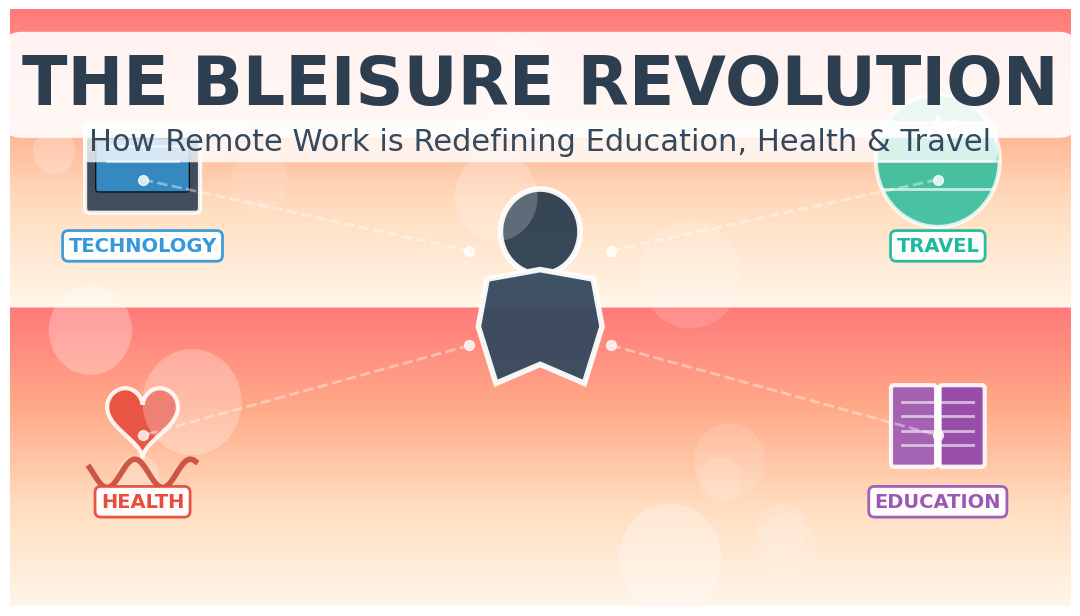
The modern professional is no longer choosing between a career and a life well-lived—they're merging both into a single, seamless experience. Welcome to the era of "bleisure" travel (business + leisure), a movement that's exploded from a niche trend into a half-trillion-dollar global phenomenon. But this isn't just about extending your stay in Paris after a conference. It's fundamentally reshaping how we approach continuous education, preventive health, and human connection in an increasingly digital world.
The Numbers Don't Lie: A Market Transforming Overnight
The global bleisure travel market was valued at approximately 594 billion in 2023** and is projected to skyrocket to **3.5 trillion by 2033 [^0^]. That's not gradual growth—that's a complete market transformation. In 2026 alone, the market is expected to grow from 816 billion to nearly514 billion at a CAGR of 9.4% depending on analysis methodology [^1^].
What's driving this? 83% of business travelers have taken a bleisure trip in the past year, and 89% want to add leisure time to their next business trip [^3^]. But here's what's fascinating: this trend isn't just changing travel—it's creating ripple effects across education and health.
The Education Divide: Who Gets to Learn Anywhere?
Remote work and bleisure travel are inextricably linked to education levels—and this reveals a critical equity issue. According to 2025 Bureau of Labor Statistics data, 42.8% of workers with advanced degrees have remote work access, compared to just 9.1% of those with only a high school diploma [^4^].
This "education gap" in remote work access means that higher education isn't just opening doors to better jobs—it's literally determining who can turn the world into their classroom. Digital nomads, the extreme end of bleisure travelers, are predominantly highly educated professionals leveraging remote work to fund continuous learning through immersive cultural experiences.
But here's the twist: the skills required for bleisure-enabled careers are themselves becoming the curriculum. Forward-thinking educational institutions are now offering courses in "remote work professionalism," cross-cultural digital communication, and even "travel hacking" for sustainable long-term mobility. The ability to work from a café in Lisbon or a co-working space in Bali isn't just a perk—it's becoming a measurable professional competency.
The Health Paradox: Are We Actually Getting Healthier?
You might assume constant travel would wreak havoc on health. Surprisingly, the data suggests otherwise—for certain groups.
Digital nomads report higher rates of physical activity than traditional office workers. According to 2026 nomad statistics, hiking ranks as the #1 physical activity among digital nomads, followed by fitness, running, and yoga [^6^]. 38% of nomads don't eat meat, with 11% identifying as vegetarian and 11% as vegan—significantly higher than global averages [^7^].
However, this rosy picture comes with caveats. Healthcare access across borders remains a top concern for remote workers, driving innovation in specialized nomad insurance products [^8^]. The 2026 digital health landscape is responding with "closed-loop care" systems—remote monitoring that doesn't just collect data but triggers actual clinical interventions [^9^].
The real health benefit might be psychological. Bleisure travelers report lower burnout rates and higher job satisfaction [^10^]. When your Tuesday meeting is followed by a Wednesday morning surf session in Portugal, the traditional work-life boundary dissolves into something more sustainable: work-life integration.
Technology: The Invisible Infrastructure Making It Possible
None of this would exist without the technological backbone enabling seamless remote work. But 2026 marks a shift: AI is becoming operational infrastructure, not a pilot project [^11^].
For bleisure travelers, this means:
AI-driven itinerary planners that balance meeting schedules with optimal leisure windows [^12^]
Cybersecurity frameworks protecting corporate data across global networks (a critical concern given that 90% of executives believe remote workers pose greater security risks) [^13^]
Virtual care platforms providing healthcare continuity across borders [^14^]
The technology stack for bleisure is increasingly sophisticated. It's not just about having a laptop and Wi-Fi anymore—it's about integrated systems that handle compliance, security, health monitoring, and productivity optimization across multiple time zones and jurisdictions.
The Demographics: Who's Actually Doing This?
If you're picturing a 20-something influencer, think again. The highest rate of remote work adoption is among workers aged 35-44 (27.4%)—mid-career professionals with established expertise [^15^]. Millennials make up 36.5% of remote workers, but Gen Z is entering the workforce with different expectations: they view travel as a right, not a perk, and prioritize mental health and cultural exploration [^16^].
Gender patterns are also shifting. Women telework at higher rates (24.5%) than men (20.1%), partly reflecting caregiving responsibilities and occupational distribution [^17^]. However, since January 2025, over 212,000 women aged 20+ have exited the U.S. workforce, partially attributed to reduced remote work options—suggesting that flexibility isn't just a "nice-to-have" but a workforce participation requirement for many [^18^].
The Future: What This Means for Your Career (and Life)
Bleisure travel is evolving from a trend to a permanent feature of the global workforce [^19^]. Countries are racing to create digital nomad visas, with the number of such programs expected to multiply through 2026 [^20^].
For professionals, this means:
Continuous education is becoming location-based and experiential
Health management requires proactive, tech-enabled solutions
Career advancement increasingly values adaptability and cross-cultural competence
Work-life balance is being replaced by work-life integration
The companies winning the talent war aren't just offering remote work—they're offering geographic autonomy with the infrastructure to support it. That includes formalized bleisure policies, cybersecurity training (currently only offered by 34% of organizations with formal programs) [^21^], and health benefits that travel with the employee.
Final Thought
The bleisure revolution isn't really about travel. It's about the democratization of place—the ability to choose where you live, learn, and heal based on your personal optimization rather than your employer's physical footprint. As AI handles more routine tasks and remote collaboration tools mature, the competitive advantage shifts to those who can effectively integrate work into a globally mobile lifestyle.
The question isn't whether bleisure will change your industry. It's whether you'll adapt to the infrastructure, education, and health frameworks that make it possible—or get left behind in the office.
Sources: All statistics and trends cited are from 2025-2026 industry reports, Bureau of Labor Statistics data, and verified market research from authoritative travel, health, and remote work publications.