The Paradigm Shift: From Destruction to Reprogramming
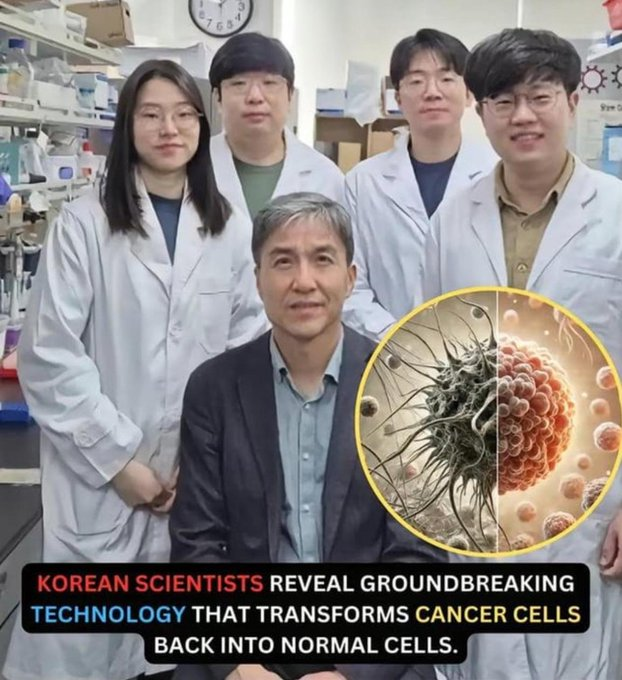
A team of researchers at the Korea Advanced Institute of Science and Technology (KAIST) has achieved a major breakthrough in cancer treatment—developing a technology that can convert cancer cells back into normal, healthy cells without destroying them .
For decades, cancer treatment has followed a single paradigm: kill the cancer cells. Chemotherapy, radiation, and even modern immunotherapies all aim to eliminate malignant cells, often causing severe side effects and collateral damage to healthy tissue. This new approach, called cancer reversion therapy, fundamentally challenges that paradigm by reprogramming cancer cells to regain their normal function .
How It Works: The "Digital Twin" Approach
Led by Professor Kwang-Hyun Cho, the research team developed a computational framework called BENEIN (Boolean Network Inference and Control) to create a "digital twin" of the gene regulatory networks that control cell differentiation .
The process works in three key steps:
1. Mapping the Network: Using single-cell RNA sequencing data from 4,252 colon cells, the team mapped a network of 522 genes and 1,841 interactions involved in normal intestinal cell development .
2. Identifying Master Regulators: Through computational simulation, they identified three critical "master regulator" genes that keep cancer cells locked in a malignant state:
- MYB – Promotes proliferation and blocks cellular maturation
- HDAC2 – Silences tumor-suppressor genes through epigenetic regulation
- FOXAA2 – Supports aberrant growth signals in cancer
3. Reprogramming the Cells: When researchers simultaneously inhibited these three genes in colorectal cancer cells, the cells stopped uncontrolled growth and began resembling healthy intestinal cells (enterocytes)—effectively reverting to a normal-like state .
Experimental Validation
The findings weren't just theoretical. The research team validated their approach through:
- In vitro experiments: Colorectal cancer cell lines showed reversion to normal-like enterocytes
- Animal studies: Mice receiving reprogrammed cancer cells developed significantly smaller tumors compared to untreated controls
Critically, this approach does not involve permanent gene editing. Instead, it uses reversible techniques like RNA interference (siRNA) to temporarily turn off cancer-promoting genes .
Why This Matters
Traditional Therapy destroys cancer cells, causes collateral damage to healthy tissue, carries risk of resistance and recurrence, and involves systemic toxicity.
Cancer Reversion Therapy reprograms cancer cells, minimizes side effects, addresses the root cause of malignancy, and offers a targeted, precision approach.
Professor Cho emphasized the significance: "The fact that cancer cells can be converted back to normal cells is an astonishing phenomenon. This study proves that such reversion can be systematically induced."
The Science Behind the Discovery
The research builds on attractor landscape theory—a concept from dynamical systems theory where cell identities exist as stable "valleys" (attractors) in a regulatory landscape. Cancer represents a misdirected attractor where cells are stuck in a pathological state. The KAIST team's innovation was discovering how to push cancer cells back into the "valley" of normal cell identity .
A subsequent study published in January 2025 further advanced this work by identifying the critical transition state—the tipping point where normal cells become cancerous. The team discovered that at this precise moment, a molecular "reversion switch" exists that can reverse the cancerization process, identifying additional targets including YY1, MYC, and USP7 .
What's Next?
The research findings have been transferred to BioRevert Inc., a biotech company founded to develop practical cancer reversion therapies . While the technology is still in preclinical stages, it represents a foundational platform that could potentially be applied to various cancer types beyond colorectal cancer.
Citation:
Gong, J., et al. (2024). Control of Cellular Differentiation Trajectories for Cancer Reversion. Advanced Science. https://doi.org/10.1002/advs.202402132
Civic Watch Media | Truth. Accountability. Public Interest.
Disclaimer: This research is at the preclinical stage. Clinical trials are required before this therapy becomes available for patients. This article is for informational purposes only and does not constitute medical advice.