By Civic Watch Media
December 2025 Review | Oslo, Norway
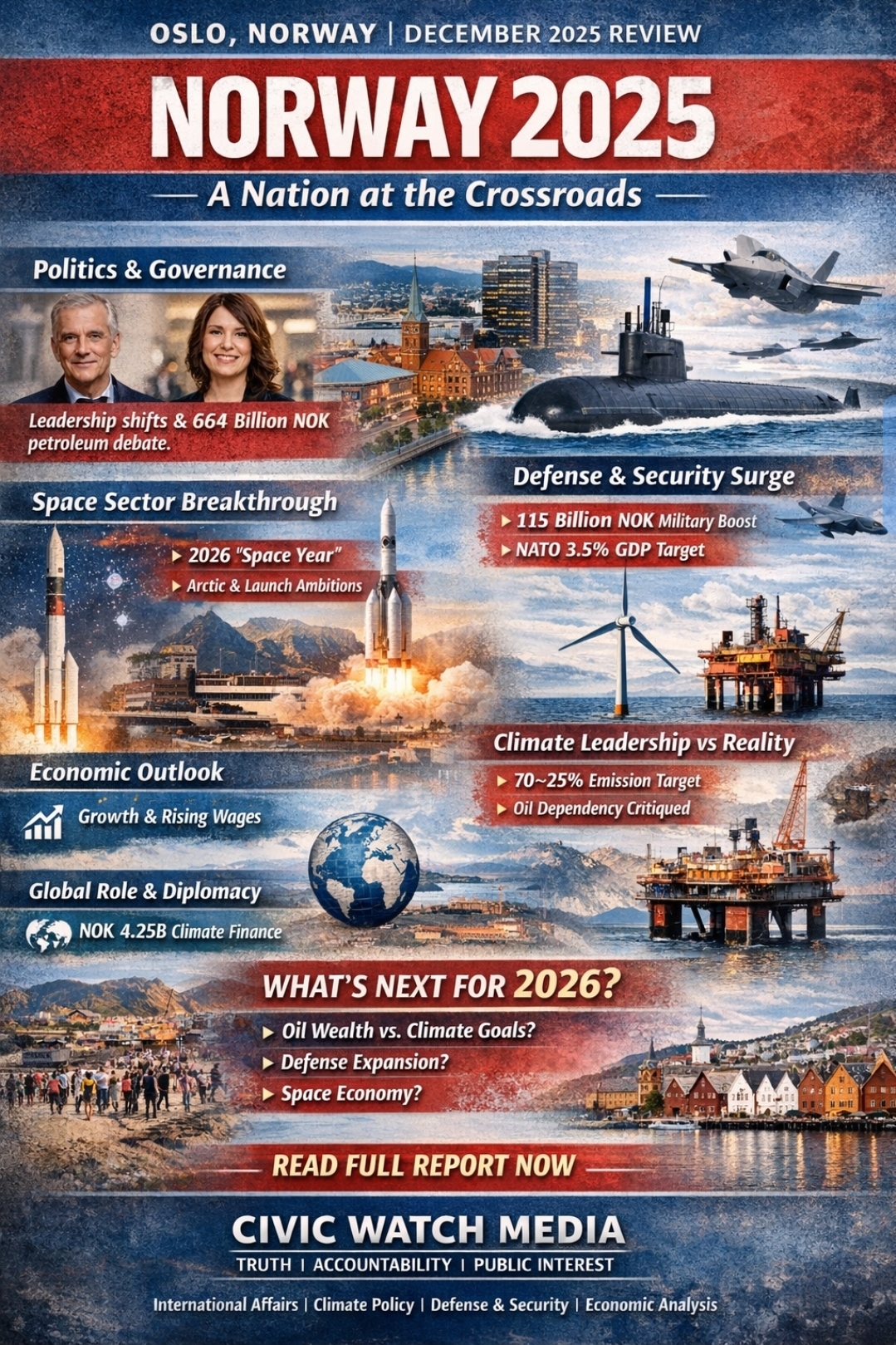
Overview: A Nation at the Crossroads
The year 2025 marked a pivotal period for Norway as the country navigated complex transitions across economic, security, environmental, and technological domains. While maintaining its position as one of Europe's most stable economies, Norway confronted pressing challenges including escalating defense requirements, the imperative to diversify beyond fossil fuels, and the need to balance climate leadership with energy security obligations.
Political Landscape: Government Restructuring
In September 2025, Prime Minister Jonas Gahr Støre's Labour government underwent significant restructuring. Minister of Trade and Industry Cecilie Myrseth emerged as a prominent voice, championing Norway's ambitious space sector expansion. The government maintained its commitment to social democratic policies while adapting to mounting pressures for economic diversification and security investment.
The administration faced particular scrutiny over its management of the petroleum sector, with the Ministry of Energy reporting state net cash flow from petroleum activities estimated at 664 billion NOK (approximately 60 billion USD) in 2025 . Minister Terje Aasland emphasized that "the revenues from the petroleum industry are very large and important for financing our welfare state," while acknowledging the need for stable regulatory frameworks to ensure Norway remains a "stable and long-term supplier of energy" for Europe .
Defense and Security: Unprecedented Military Investment
Perhaps the most consequential development of 2025 was Norway's dramatic defense buildup. In March 2026 (reflecting late 2025 decisions), the government announced an additional 115 billion Krone (11.8 billion USD) in defense spending through 2035, supplementing the revised Long-term Defence Plan initially approved in 2024 .
This investment positions Norway to reach NATO's 3.5 percent GDP spending target by 2035, a significant increase from current levels. Prime Minister Støre justified the expenditure by citing rising defense equipment costs and new strategic insights gained from the Ukraine conflict: "We are therefore allocating a significant increase in resources to the long-term plan, while also carefully weighing the priorities needed to rapidly strengthen Norway's defence capabilities" .
Key Procurement Priorities:
Advanced Munitions: Norway expects to finalize a deal by year-end for Northrop Grumman's AARGM-ER missiles, compatible with its F-35 fighter fleet, with deliveries scheduled between 2031-2032 .
Naval Expansion: Accelerated acquisition of six Type 212CD submarines from Germany's ThyssenKrupp Marine Systems and at least five Type 26 Anti-Submarine Warfare frigates from UK shipbuilder BAE Systems. The frigates will integrate maritime helicopters with anti-submarine warfare capabilities .
Arctic Readiness: The Finnmark Brigade expansion was accelerated by two years, with full operational capability now targeted for 2032. This specialized unit is designed to bolster NATO's presence in the strategically critical Arctic region .
Notable Cancellation: Despite Leonardo's offer of AW101 helicopters as part of a package deal with the Type 26 frigates, Oslo opted against immediate rotorcraft procurement. Additionally, a planned acquisition of long-range maritime surveillance drones was cancelled in favor of potential collaboration with the UK on MQ-9B SkyGuardian aircraft and enhanced space-based surveillance capabilities .
NATO's 2025 annual report highlighted Norway's integral role in Alliance operations, including participation in the Dynamic Mongoose 25 anti-submarine warfare exercise in the High North and the establishment of a new Combined Air Operations Centre in Bodø, Norway, enhancing NATO's Arctic command structure .
Space Sector: Norway's New Frontier
December 2025 witnessed a landmark moment for Norway's emerging space industry. At the Spaceport Norway 2025 conference in Oslo, Minister Cecilie Myrseth unveiled an ambitious strategy to establish Norway as a major European space power .
Three Strategic Pillars:
Arctic Leadership: Norway aims to become the global leader in situational awareness in the High North, leveraging its geographic advantages for satellite monitoring and space domain awareness.
Global Launch Hub: Development of Andøya Spaceport into "one of the world's most attractive sites for satellite launches," securing Europe's independent access to space and reducing reliance on non-European launch providers.
Civil-Military Synergy: Enhanced cooperation between civilian and military space applications to build collective European resilience against emerging space-based threats .
Minister Myrseth announced that 2026 will be designated Norway's "space year" to showcase national capabilities globally. The government is preparing a new parliamentary report (Stortingsmelding) to facilitate what officials describe as a "significant gear shift" in Norwegian space activity .
The conference drew 180 key stakeholders from across Norway, the Nordic region, and Europe, signaling robust industry confidence in the sector's high-growth trajectory. However, participants emphasized the need for concrete policy mechanisms to translate national ambitions into sustainable commercial success .
Climate Policy: Ambition Versus Reality
Norway's climate strategy in 2025 presented a complex picture of progressive targets coexisting with continued fossil fuel dependency.
Legislative Advances:
In June 2025, Norway updated its Climate Change Act, establishing a new target of 70-75% greenhouse gas emissions reduction by 2035 compared to 1990 levels . The country also submitted its Nationally Determined Contribution (NDC) for 2035 under the Paris Agreement, maintaining its commitment to carbon neutrality by 2050 with interim five-yearly targets .
Norway leads globally in renewable energy deployment, ranking first among all countries in the Climate Change Performance Index's renewable energy category . The country generates nearly all electricity from renewable sources, primarily hydropower, and achieved approximately 90% electric vehicle market share for new automobile registrations in 2024, with plans to complete the phase-out of fossil fuel vehicle sales by end of 2025 .
Persistent Contradictions:
Despite these achievements, climate advocates identified significant gaps. The Climate Change Performance Index downgraded Norway two positions to 11th overall, citing "low" ratings in climate policy and "very low" in energy use .
Critics highlighted that Norway's 2035 target relies heavily on "flexible mechanisms"—international emissions trading—rather than purely domestic reductions . The country maintains no specific plan to phase out oil and gas production, with the government explicitly stating it "will not prepare a strategy for the final phase of Norwegian oil and gas" but instead aims to remain "a stable and predictable supplier" with low-emission production methods .
Environmental organizations, including 350.org, condemned this approach as "burying its head in the sand," arguing that Norway's fair share requires at least 80% domestic emissions reduction by 2035 and a clear fossil fuel phase-out timeline aligned with 1.5°C warming limits .
Indigenous rights concerns also persisted, with renewable energy projects—particularly hydropower and wind developments—continuing to impact Sámi lands without adequate consultation or compensation .
Economic Performance: Resilience Amid Transition
Norway's mainland economy demonstrated robust performance throughout 2025. According to Statistics Norway's Economic Survey, household consumption—accounting for approximately half of mainland GDP—grew by 3% in the first half of 2025 compared to the same period in 2024, following a 1.5% increase in 2024 .
Key economic indicators revealed:
- Real wage growth returned after years of stagnation, driven by higher wage income and lower interest rates
- Housing investment recovered following a nearly 20% decline in 2023
- Business investment remained elevated, particularly in power supply and select manufacturing segments
- Consumer confidence improved, supported by strong growth in real disposable income and wealth
The Norwegian krone showed signs of stabilization after struggling throughout 2023 and 2024, though currency volatility remained a concern for import-dependent sectors .
International Climate Diplomacy
Norway maintained its position as a significant climate finance contributor, pledging NOK 4.25 billion (approximately 420 million USD) to its International Climate and Forest Initiative, extending efforts to reduce tropical deforestation through 2035 .
The government's Climate Strategy for the Foreign Service 2025-2030 emphasized integrating climate considerations across diplomatic priorities, including conflict prevention, Arctic cooperation, and development policy. Norway highlighted its role in the UN Security Council (2021-2022) in advancing climate-security linkages and supported initiatives such as weather index insurance schemes for African nations vulnerable to climate disasters .
However, Norway resisted joining the Beyond Oil & Gas Alliance (BOGA), maintaining its position that natural gas remains essential for European energy security during the transition period .
Social and Demographic Trends
Immigration patterns shifted notably in 2025. Research indicated that significantly fewer foreign workers chose Norway as a destination, marking a major reversal of a two-decade trend that had shaped the national labor market . The Norwegian Directorate of Immigration reported pessimistic projections for case processing times, citing insufficient government funding for 2025 operations .
Tourism management remained contentious, with continued debate over visitor pressure in popular regions such as Lofoten and Bergen. Authorities implemented new travel regulations including a planned tourist tax and infrastructure investments, while promoting lesser-known destinations to distribute visitor impact more evenly .
Looking Forward: 2026 and Beyond
As Norway enters 2026, several critical questions define the national agenda:
- Can the space sector translate policy ambition into commercial viability?
- Will defense investments achieve NATO targets while maintaining social welfare commitments?
- How will Norway navigate the tension between climate leadership and petroleum dependency?
- Can the economy maintain growth while managing krone volatility and labor market transitions?
The Støre government's ability to balance these competing priorities will determine whether 2025 marked the beginning of a successful strategic transformation or merely acknowledged challenges that remain unresolved.
Civic Watch Media will continue monitoring Norway's evolution as it shapes its role in European security, climate action, and technological innovation.
Classification: International Affairs | European Politics | Climate Policy | Defense & Security | Economic Analysis
Sources: Norwegian Government Official Releases, NATO Secretary General Annual Report 2025, Statistics Norway Economic Survey, Climate Change Performance Index 2026, Spaceport Norway Conference Proceedings, Breaking Defense, European Environment Agency