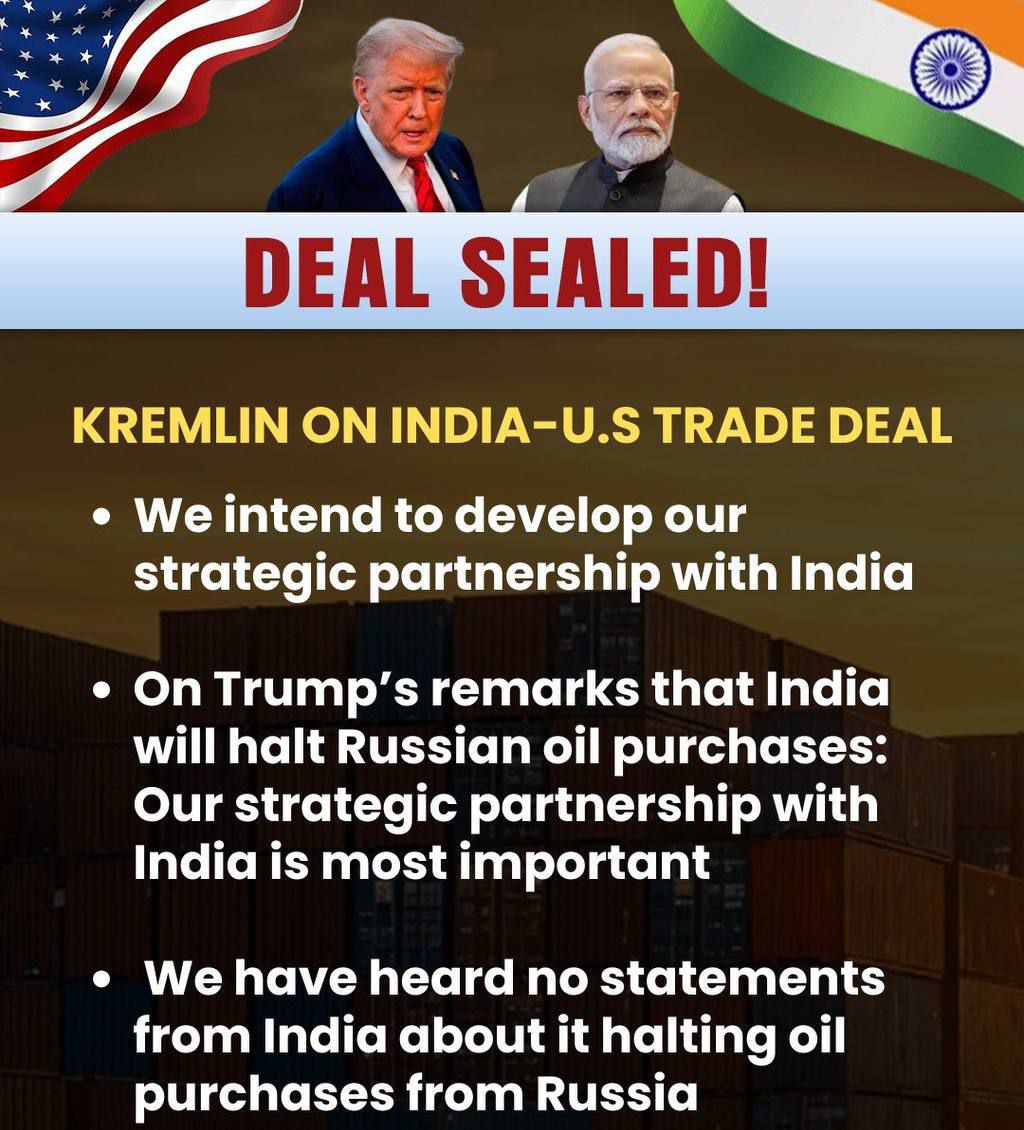
MOSCOW — The Kremlin has officially pushed back against President Donald Trump's assertions that India will halt Russian oil purchases, stating categorically that "we have heard no statements from India about it halting oil purchases from Russia" .
The diplomatic clarification comes as Washington attempts to tighten the screws on Moscow's energy revenues, with Trump claiming credit for a supposed breakthrough in India-U.S. trade negotiations that would see New Delhi pivot away from discounted Russian crude.
The Kremlin Position: Strategic Partnership Intact
Russian officials emphasized that their strategic partnership with India remains the most important bilateral relationship in Asia, brushing aside Trump's remarks as premature or unfounded .
Key Kremlin Statements:
The Kremlin intends to develop its strategic partnership with India further, indicating long-term commitment beyond immediate trade pressures. Regarding Trump's specific claims about Indian oil purchase halts, Moscow noted that no such statements have emerged from New Delhi itself. The strategic partnership with India is characterized as most important, suggesting Russia views the relationship as non-negotiable regardless of external pressure.
Trump's Claim vs. Ground Reality
President Trump had suggested that a sealed India-U.S. trade deal included commitments for India to reduce or eliminate Russian oil imports—a cornerstone of Moscow's wartime revenue stream. The Kremlin's rebuttal exposes a potential gap between American diplomatic messaging and actual Indian policy.
The Numbers Context:
India has emerged as the largest buyer of discounted Russian crude since Western sanctions were imposed, saving billions in import costs while providing Moscow a critical lifeline. Any genuine Indian pivot would represent a severe blow to Russian finances and a major diplomatic victory for Washington.
New Delhi's Silent Strategy
The Indian government's notable silence on Trump's claims speaks volumes. New Delhi has masterfully balanced relations—extracting cheap energy from Russia while deepening security cooperation with the United States. Public confirmation of a Russian oil halt would:
- Inflate India's energy import bill by 15-20 billion annually
- Damage long-standing defense and nuclear partnerships with Moscow
- Eliminate leverage in ongoing trade negotiations with Washington
The "War Ending" Factor
Market observers and geopolitical analysts note an underlying reality that may render the dispute moot: the Russia-Ukraine conflict appears headed toward resolution. If hostilities cease in the coming months, as increasingly suggested by diplomatic channels, Western sanctions architecture would likely unravel—legitimizing Russian oil trade without political complications .
This prospect explains India's cautious positioning. Why commit to damaging a longstanding partnership when the geopolitical landscape may shift dramatically in weeks?
Implications for Global Energy Markets
If Trump Prevails:
- Russian oil prices would face additional downward pressure
- Brent crude could spike on supply reallocation disruptions
- India would need alternative suppliers (Saudi Arabia, UAE, U.S. LNG)
If Kremlin Position Holds:
- Discounted Russian crude continues flowing to India
- Moscow maintains critical revenue stream
- U.S.-India trade negotiations face friction over enforcement
The Bottom Line
The Kremlin's statement exposes the fragility of Trump's claimed breakthrough. Until New Delhi speaks, Moscow's discounted oil keeps flowing—and India's strategic autonomy remains intact. With peace talks potentially ending the Ukraine war soon, this diplomatic friction may resolve itself before causing lasting damage to any bilateral relationship.
For now, Russia's message is clear: talk to us when India actually says something.
Civic Watch Media will continue monitoring developments as India-U.S. trade negotiations progress.