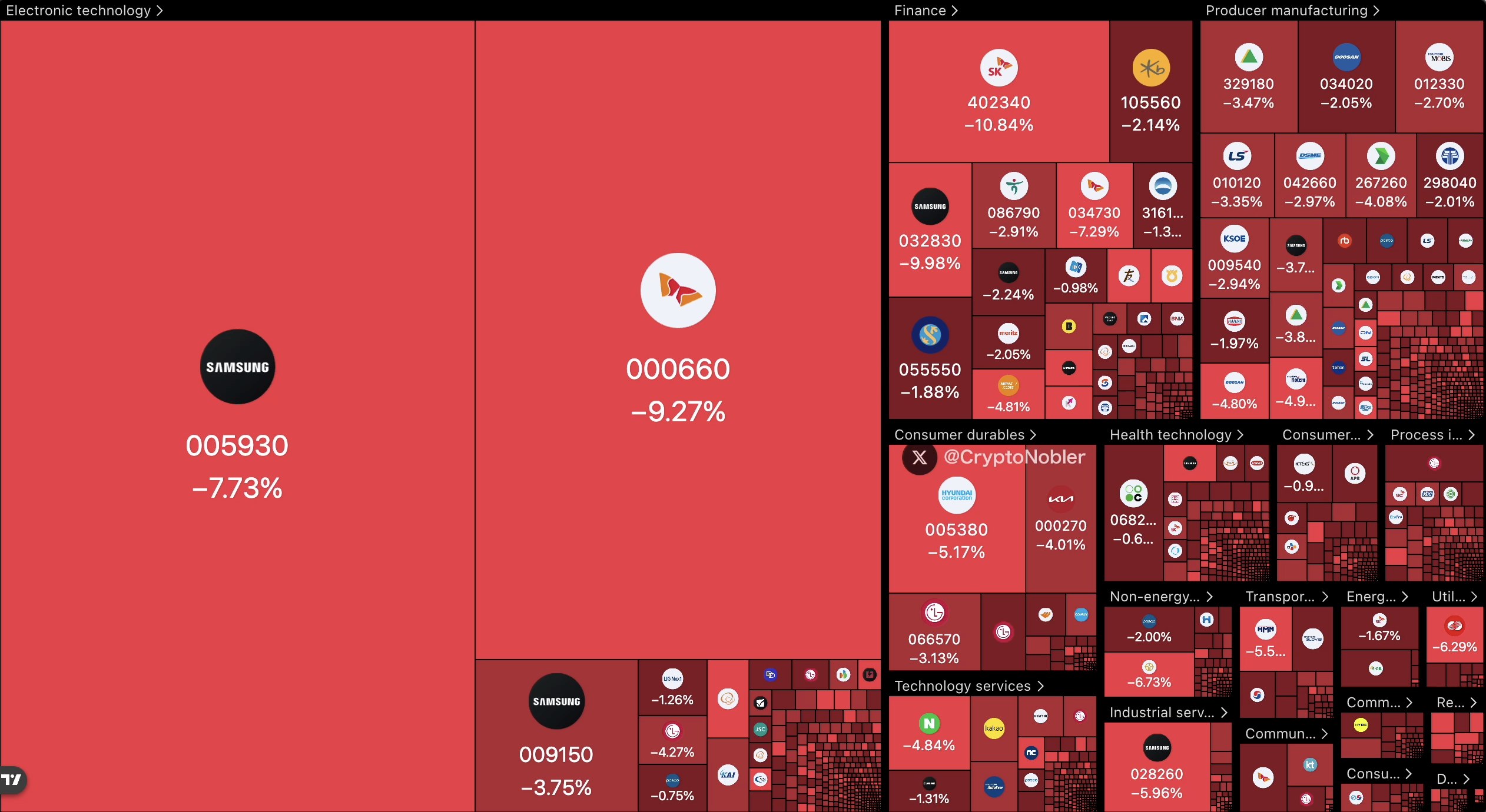
South Korea’s stock market came under intense pressure on Wednesday, August 19, as a sharp technology-sector sell-off sent the benchmark KOSPI plunging more than 6% during trading.
The decline was led by the country’s semiconductor giants, Samsung Electronics and SK Hynix, whose shares fell sharply amid a broader global retreat from technology and artificial-intelligence stocks. Samsung dropped about 7.5%, while SK Hynix declined roughly 8.8% during the session.
📉 KOSPI TRIGGERS SELL-SIDE HALT
The scale of the decline prompted the Korea Exchange to activate a sell-side “Sidecar” mechanism, temporarily suspending program selling for five minutes.
Importantly, this was not a full market-wide trading halt. Ordinary stock trading continued, while the Sidecar mechanism was activated to temporarily cool automated selling after KOSPI 200 futures fell sharply.
The KOSPI subsequently fell to around the 6,400 level, with reports putting the intraday decline at more than 6%.
💰 MASSIVE MARKET VALUE UNDER PRESSURE
The rapid fall in Samsung Electronics, SK Hynix and other major Korean companies erased a huge amount of market capitalization in a short period.
However, claims circulating online that ₩280 trillion was definitively wiped out in exactly 15 minutes have not been independently verified by the sources reviewed by Civic Watch Media.
🌏 WHAT IS BEHIND THE SELLOFF?
The Korean market's weakness is part of a wider global risk-off move. Investors are reacting to renewed pressure on technology and semiconductor stocks, rising government bond yields, higher oil prices and concerns over the sustainability of extremely high valuations in AI-related companies.
The sell-off has also spread across other Asian markets, with Japan's Nikkei suffering a major decline alongside South Korea.
🔎 WHY SAMSUNG AND SK HYNIX MATTER
Samsung Electronics and SK Hynix are among the world's most important memory-chip manufacturers. Their enormous weight in South Korea's stock market means sharp movements in their shares can have an outsized impact on the KOSPI.
The latest decline therefore represents more than just a fall in two individual companies—it highlights the vulnerability of Asian markets to a sudden reversal in global technology sentiment.
Civic Watch Media will continue monitoring developments in Seoul and global financial markets as investors assess whether today's sell-off represents a temporary correction or the beginning of a broader market downturn.
This report is for news and informational purposes only and should not be considered financial advice.
— CIVIC WATCH MEDIA
Watching the Markets. Reporting What Matters.