THE CLASSIFIED FOREX PLAYBOOK
Why Most Traders Lose — And How Smarter Traders Adapt
By Civic Watch Media | Market Education & Analysis
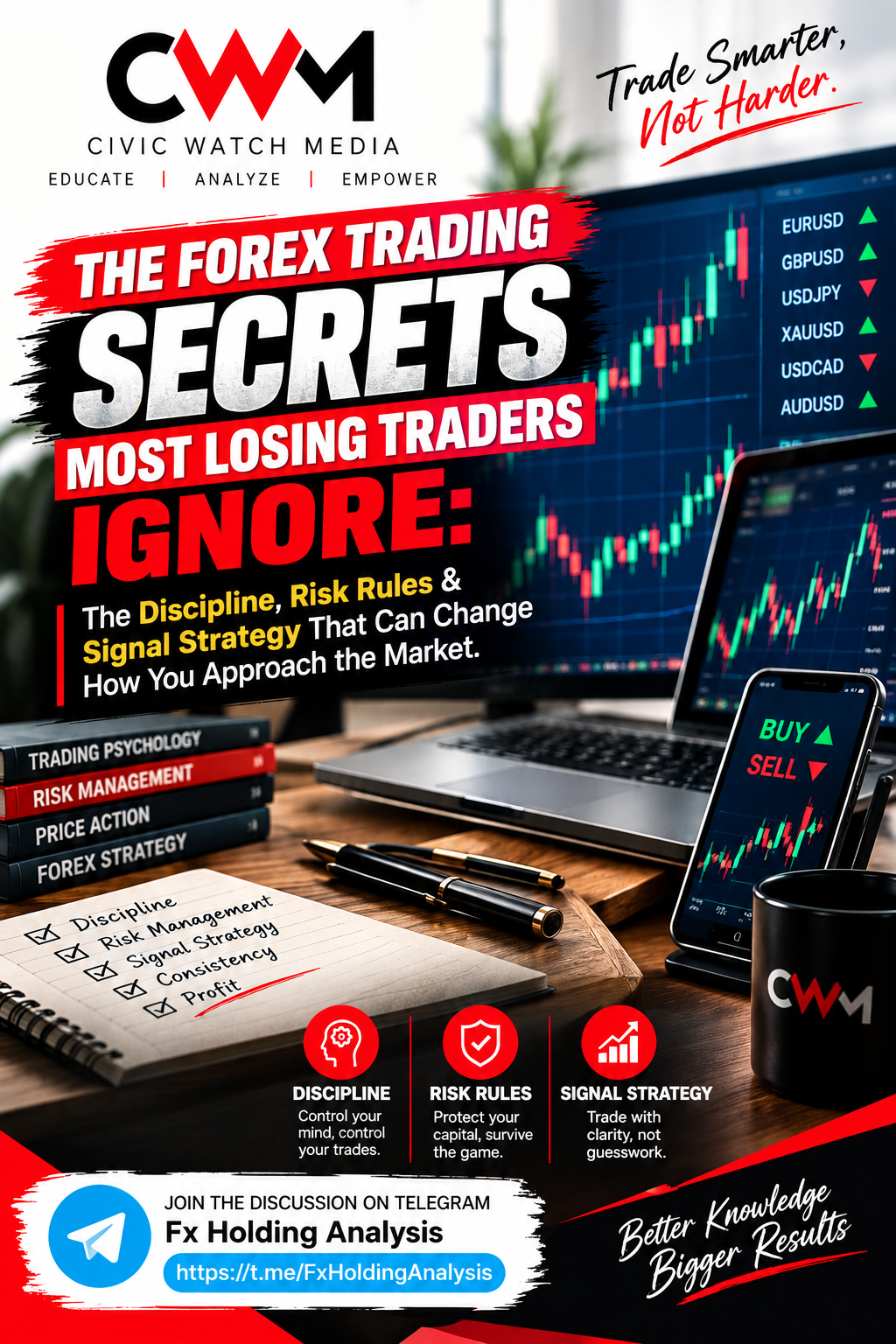
Forex trading rewards discipline, not excitement. Yet many traders enter the market with unrealistic expectations, excessive leverage, emotional decisions and little understanding of risk. The result is a familiar cycle: enter late, overtrade, increase position size after a loss, panic during volatility—and eventually watch an account deteriorate.
The difference between a struggling trader and a disciplined trader often begins with one principle: protect capital before pursuing opportunity.
THE MOST COMMON TRADING ERRORS
1. Trading without a defined strategy
Entering the market simply because a currency pair is moving is not a strategy. Traders should know what conditions must exist before entering and what would invalidate the setup.
2. Overleveraging
Leverage can magnify gains, but it can magnify losses just as quickly. A single oversized position can damage an account far beyond what several successful trades can recover.
3. Revenge trading
After taking a loss, some traders immediately enter another position to “recover” the money. This transforms analysis into emotion.
4. No stop-loss discipline
A trader who refuses to accept a small controlled loss can eventually face a much larger one.
5. Chasing the market
When a move has already occurred, jumping in because of FOMO can mean buying near resistance or selling near exhaustion.
6. Overtrading
More trades do not automatically mean more opportunities. Sometimes the strongest decision is to remain outside the market.
7. Ignoring economic events
Interest-rate decisions, inflation data, employment reports and geopolitical developments can produce extreme volatility. Traders should understand the economic calendar before exposing capital.
8. Treating every signal as certainty
No legitimate market signal is infallible. Signals should be treated as analytical inputs—not guarantees.
THE SMARTER APPROACH
A professional trading routine begins before the order button is touched.
Analyse → Plan → Execute → Protect → Review.
Define the entry zone, stop-loss, potential target and acceptable risk before entering. Avoid risking money you cannot afford to lose, and maintain a consistent position-sizing method.
Keep a trading journal. Record the setup, reason for entry, risk level, outcome and emotional state. After enough trades, patterns in your own behaviour become visible.
Most importantly, learn to distinguish quality setups from market noise.
WHERE PREMIUM SIGNALS CAN FIT
For traders who do not want to analyse every market movement alone, curated signal services can serve as an additional research layer.
FX Holding Analysis can be followed as a source of market ideas, trade setups and premium signals—but traders should still conduct their own assessment, understand the stated risk and never assume that a signal guarantees a profitable outcome.
The objective should not be to blindly copy trades.
The objective is to combine quality market information with disciplined execution and risk management.
Before acting on any signal, traders should consider the entry, stop-loss, target, market conditions, leverage and their own risk tolerance.
THE CLASSIFIED RULE
Capital preservation comes first. Opportunity comes second.
The market will always produce another setup. A trader does not need to win every trade; the goal is to develop a process where losses remain controlled and decisions remain consistent.
STAY AHEAD. STAY INFORMED.
Pin Civic Watch Media across your platforms so you don't miss important market intelligence, financial developments and educational analysis.
Follow FX Holding Analysis through its official media channels for its latest market observations and premium signal updates.
Civic Watch Media
Independent. Informed. Global.
FX Holding Analysis
Market intelligence. Structured signals. Disciplined trading.
Risk Warning: Forex and leveraged trading involve substantial risk and can result in the loss of capital. Past performance does not guarantee future results. Signal information is educational/analytical and should not be treated as guaranteed financial advice or a promise of profit.