CIVIC WATCH MEDIA | CLASSIFIED MARKET ALERT
Global financial markets are entering a potentially sensitive period as investors closely monitor U.S. Treasury markets, Japanese and Chinese holdings of U.S. government debt, liquidity conditions and corporate share buybacks.
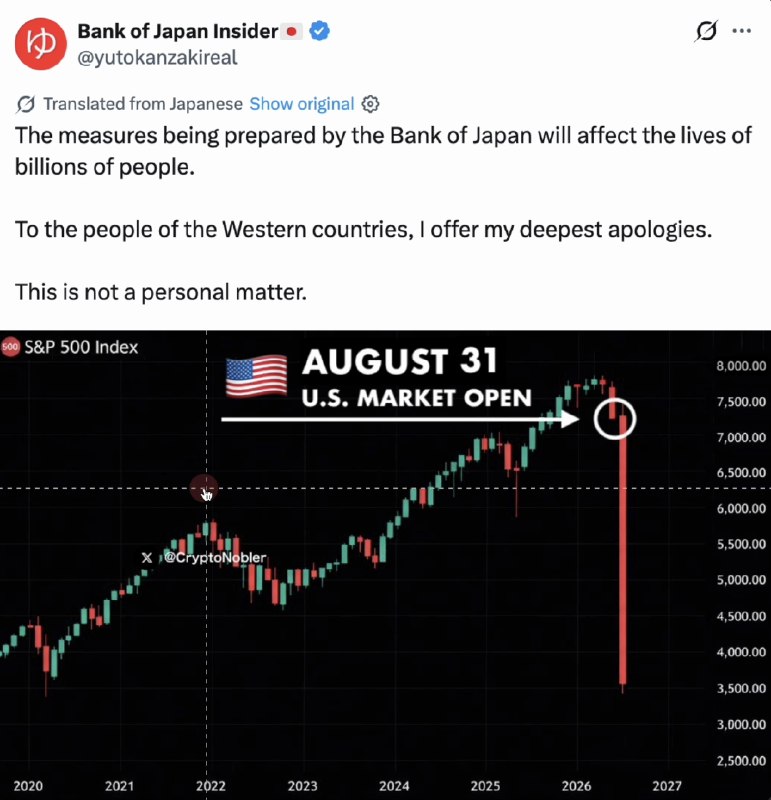
Claims circulating online that Japan is dumping $5.25 trillion in U.S. Treasuries and China is dumping $600 billion, alongside warnings that August 31 could trigger a historic market collapse, have intensified concerns among traders and investors.
However, these figures and the prediction that 99% of people will lose everything should not be treated as confirmed facts without official data.
🇯🇵 JAPAN AND THE U.S. TREASURY MARKET
Japan remains one of the world's largest foreign holders of U.S. Treasury securities. Any significant change in Japanese Treasury holdings can attract market attention because large-scale selling could influence bond prices, Treasury yields, the U.S. dollar and global liquidity.
But a country's total Treasury holdings should not automatically be interpreted as an immediate plan to liquidate the entire position.
🇨🇳 CHINA'S TREASURY POSITION
China is also a major participant in the U.S. Treasury market. Changes in Chinese holdings are closely watched because they can affect perceptions of global demand for U.S. government debt.
A sustained reduction in holdings could become significant, but it does not necessarily mean that China is preparing for a sudden $600 billion liquidation.
🇺🇸 WHY BUYBACKS MATTER
Another major factor attracting attention is the scale of corporate share repurchases.
Buybacks can support stock prices by reducing the number of shares outstanding and returning capital to shareholders. However, buybacks should not automatically be interpreted as a government rescue operation or proof that Washington is attempting to “cover” Treasury losses.
⚠️ WHAT INVESTORS SHOULD ACTUALLY WATCH
Rather than preparing for a guaranteed financial collapse, investors should monitor:
• U.S. Treasury yields and auction demand
• Japanese and Chinese Treasury holdings
• U.S. dollar strength
• Federal Reserve liquidity conditions
• Equity-market volatility
• Corporate earnings and buyback announcements
• Credit-market stress
• Major economic data releases
📌 THE BIGGER PICTURE
The real issue is not whether “99% of people will lose everything.”
The important question is whether changing global capital flows could produce higher bond yields, increased volatility, pressure on risk assets and tighter financial conditions.
If Treasury demand weakens significantly while investors simultaneously reduce exposure to equities and other risk assets, markets could experience substantial volatility.
That is why August 31 deserves attention — not because a collapse is guaranteed, but because global investors are watching several interconnected pressure points at the same time.
CIVIC WATCH MEDIA ANALYSIS:
Markets rarely collapse simply because of one headline. Major financial events usually emerge from a combination of leverage, liquidity, investor positioning, interest rates and loss of confidence.
Stay informed. Verify before you act. Do not make investment decisions based solely on viral predictions.
🔴 CIVIC WATCH MEDIA
Facts. Intelligence. Public Awareness.