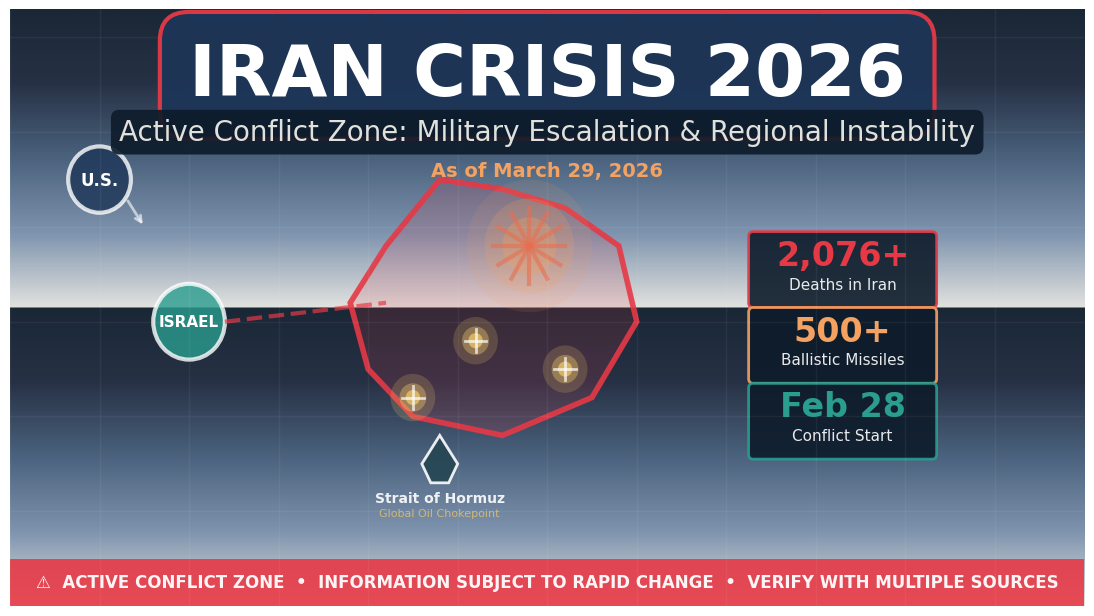
A major conflict currently ongoing between Iran, Israel, and the United States that began in late February 2026.
This appears to be a significant, fast-developing military situation.
Given the serious nature of this topic—active military conflict—I want to handle this with appropriate care and accuracy. The information below is based on the available sources, but situations like this change rapidly and verification is challenging.
Critical Update: The 2026 Iran Conflict – What We Know as of March 29, 2026
⚠️ Content Warning: This post discusses active military conflict, casualties, and geopolitical crisis.
The Situation in Brief
As of late March 2026, Iran is engaged in active military conflict with a combined U.S.-Israeli force following strikes that began on February 28, 2026. This represents one of the most significant military escalations in the Middle East in decades.
Timeline of Key Events
February 28 – March 1: The Opening Strikes
- Israeli and U.S. forces conducted coordinated strikes targeting Iranian leadership and military infrastructure
- Iranian Supreme Leader Ayatollah Ali Khamenei was killed in the initial strikes, confirmed by Iranian state media on March 1
- Multiple high-ranking officials were killed, including the defense minister, IRGC commander, and approximately 40 Iranian officials total
- Khamenei's daughter and grandchild were also reported killed
March 4: Naval Engagement
- The USS Charlotte submarine torpedoed and sank the Iranian frigate IRIS Dena in the Indian Ocean, approximately 40 nautical miles south of Sri Lanka
- This marked the first ship sunk by a U.S. submarine since World War II and the first submarine kill in combat since the Falklands War
- 104 Iranians were killed, 32 injured
March 8: Leadership Transition
- Mojtaba Khamenei, the late Supreme Leader's second son, was designated as Iran's new Supreme Leader
March 16-19: Escalation and Ground Operations
- Israel launched an invasion of Lebanon, opening a new ground front
- Iran confirmed the deaths of Intelligence Minister Khatib and Basij commander Soleimani
- President Trump threatened to "blow up" Iran's South Pars gasfield if Tehran struck Qatar
March 27-29: Recent Developments
- Iran moved to assert control over the Strait of Hormuz, blocking two Chinese ships in a rare move
- Iran announced plans to formalize a toll system for the Strait
- Israeli strikes hit Iranian steel factories and university facilities, including the Physics Department at Iran University of Science and Technology (IUST)
- A U.S. AWACS aircraft was damaged in an Iranian strike
- 12 U.S. troops were wounded in an Iranian strike on a Saudi base
- Death toll in Iran reached 2,076 as of March 29
Military and Strategic Dimensions
Air and Missile Warfare
- Iran has launched over 500 ballistic missiles and approximately 2,000 drones since the conflict began
- An Israeli F-35I "Adir" shot down an Iranian Yak-130 fighter jet—the first F-35 kill of a crewed aircraft in air-to-air combat
- NATO integrated air defense systems intercepted Iranian ballistic missiles entering Turkish airspace
Regional Spillover
- Hezbollah joined the conflict, launching missiles from Lebanon into Israel
- Strikes have hit targets in Kuwait, Saudi Arabia, Qatar, UAE, and Bahrain
- Dubai International Airport and other Gulf airports have been attacked
- UK RAF base in Cyprus was hit by a suspected drone strike
Economic Impact
- Oil flows through the Strait of Hormuz have been disrupted
- Oil and gas prices have soared globally
- "River of fire" from burning fuel depots created toxic black rain in Tehran
Diplomatic and Political Context
U.S. Domestic Response
- President Trump ordered the strikes without congressional approval, drawing criticism
- Most Americans do not support the strikes according to multiple polls
- The Senate failed to block U.S. involvement
Iranian Position
- Iran initially stated it would not negotiate with the United States
- President Pezeshkian announced Iran would stop striking neighbors from March 7 unless attacked from their territory
- Iran has vowed to strike European countries if they join the war
Humanitarian Concerns
- Nearly 700,000 displaced in Lebanon according to UNHCR
- 13 verified attacks on health sites in Iran according to WHO
- Tehran residents advised to stay indoors due to toxic smoke and "acidic black rain"
- U.S. Central Command urged Iranian civilians to stay home, alleging the regime uses civilian areas for military operations
Analysis: Why This Matters
This conflict represents several unprecedented developments:
1. Leadership Decapitation: The killing of a sitting Supreme Leader is extraordinarily rare in modern state conflicts
2. Direct U.S.-Iran Combat: Unlike previous proxy conflicts, this involves direct military engagement between the U.S. and Iranian forces
3. Strategic Waterway Control: Iran's moves on the Strait of Hormuz threaten global energy supplies
4. Multi-Front War: Simultaneous air, naval, ground (Lebanon), and missile warfare across multiple countries