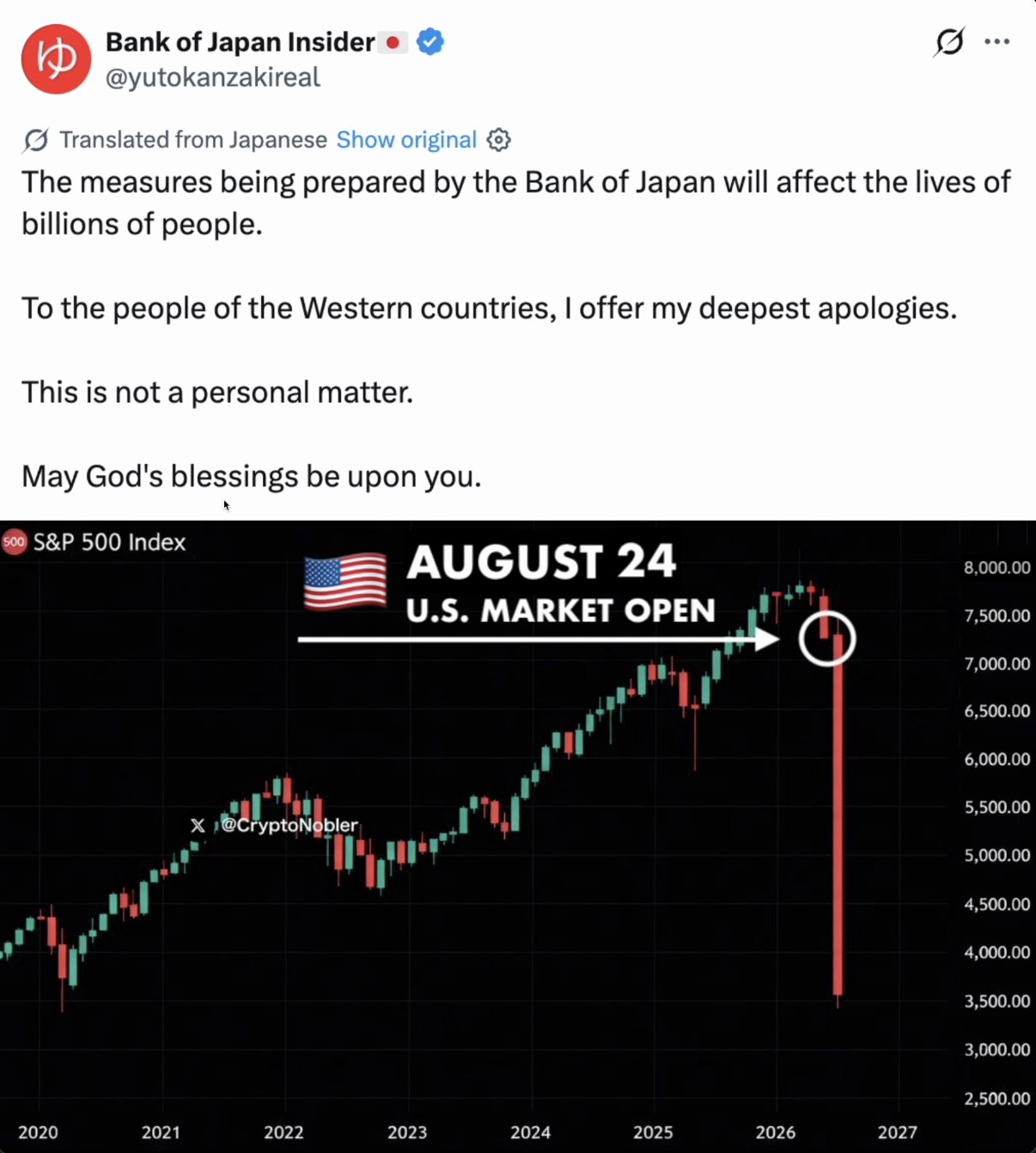
A wave of alarming financial claims circulating ahead of Monday, August 24, is fueling fears of heightened volatility across global markets, with investors closely watching Japan, China and the U.S. Treasury market.
Posts circulating online claim that Japan is preparing to dump $5.5 trillion in U.S. Treasuries, while China could sell another $650 billion, potentially creating severe pressure on U.S. bonds, the dollar and risk assets.
However, the figures circulating online require important clarification.
According to the latest U.S. Treasury data, Japan held approximately $1.117 trillion in U.S. Treasury securities at the end of June 2026, down from $1.143 trillion in May. China held approximately $633.4 billion, down from $659.3 billion.
That means the claim that Japan alone is currently "dumping $5.5 trillion" is not supported by the published Treasury holdings data.
Still, the underlying market development is significant.
Foreign holdings of U.S. Treasuries declined in June, led by reductions from Japan, China and other major holders. Reuters reported that total foreign Treasury holdings fell during the month as global investors reassessed U.S. bonds amid elevated yields and broader market uncertainty.
At the same time, Washington has taken an unusual step to support liquidity in the long-term Treasury market.
The U.S. Treasury announced that it would double the size of certain long-duration Treasury buyback operations from $2 billion to at least $4 billion per operation, beginning in September. The move came after the 30-year Treasury yield climbed to levels not seen since 2007.
The development does not mean the U.S. economy has officially "collapsed." Rather, it highlights growing concern around high borrowing costs, elevated government debt, persistent fiscal deficits and instability in the long-term bond market. U.S. government debt has now surpassed $40 trillion, adding to the pressure surrounding Treasury yields.
WHY MONDAY MATTERS
With global markets already sensitive to movements in Treasury yields, the dollar, Japanese monetary policy and geopolitical developments, any unexpectedly large move in government bonds could spill into other asset classes.
Higher Treasury yields can increase borrowing costs across the economy and put pressure on equities and other risk-sensitive assets. Conversely, a sharp fall in yields could signal a rush toward safer assets.
For traders, the key issue is therefore not whether a viral $5.5 trillion liquidation figure is accurate. It is whether the combination of foreign Treasury selling, elevated yields and aggressive Treasury market intervention produces another wave of volatility.
WHAT INVESTORS SHOULD WATCH
Markets will be watching:
• U.S. Treasury yields and auction demand
• The Japanese yen and Bank of Japan policy signals
• Chinese Treasury holdings and broader reserve allocation
• The U.S. dollar
• S&P 500 and Nasdaq futures
• Bitcoin and other high-beta assets
• Liquidity and liquidation levels across global markets
The image circulating online predicts an extreme S&P 500 collapse on the August 24 U.S. market open. That scenario should not be treated as a confirmed forecast. Charts circulating on social media can illustrate a possible scenario, but they do not establish that such a crash will occur.
CIVIC WATCH BOTTOM LINE
August 24 could bring heightened volatility, but claims of a guaranteed market crash or a $5.5 trillion Japanese Treasury dump should be treated with caution.
The real story is already serious enough: Japan and China have reduced their reported U.S. Treasury holdings, long-term U.S. yields remain elevated, and the Treasury has responded by significantly expanding its buyback operations.
Whether Monday develops into a routine volatile session or something much larger will depend on actual market flows—not viral predictions.
CIVIC WATCH MEDIA
Watch the markets. Question the headlines. Follow the data.