At least 58 Chinese Americans fought in the Civil War, constituting a largely forgotten community of soldiers and veterans whose stories have been buried beneath the dominant narratives of the conflict .
By the 1850s, Chinese Americans—who had begun arriving to the continent's western territories in the 1780s, long before they were part of the United States—had also begun to arrive and form communities on the East Coast. They came in a variety of ways: as visitors or students accompanying returning missionaries; as merchants or businessmen pursuing new opportunities; as performers or artists finding new venues; even as slaves in the era's so-called "coolie trade." By the war's outset, there were hundreds of recorded East Coast Chinese Americans (and likely many more not recorded), and many chose to enlist .
The Promise of Citizenship
The promise of citizenship likely played a significant role in Chinese American enlistment. On July 17, 1862, Congress passed the Militia Act, which granted citizenship to anyone who served in the military and was honorably discharged. There was no reference to race, and the law included resident immigrants, making Asian enlistees eligible .
There was also a small portion of the Asian population at the time who were enslaved. Similar to Black enlistees, they hoped serving in the Union Army—which was 2.67 million strong—would liberate them. They also thought fighting would give them protective rights from exploitative jobs such as the backbreaking work of building railroads .
Racial Classification: A Persistent Challenge
Confusion over racial categorization in the 1860 census, which only asked if you were "White, Black or Mulatto" and did not list "Asian" as a racial category, led enlisting Asians to either hide their identity, pass as "white" and fight alongside white soldiers while fearing threat of dismissal upon being discovered, or to fight alongside Black soldiers in the U.S. Colored Troops, lumping themselves in with "other people of color" .
This problem of categorization also led to inefficient recognition of Asian American veterans because of the difficulty in identifying if a soldier was in fact Asian American or Pacific Islander in public military records. This was also due to Anglicization or misspelling of names. While involved in the troops, they were oftentimes the "lone Asian in a white or colored regiment," and it was difficult to rise in ranks .
Notable Chinese American Veterans
Corporal Joseph Pierce (1842–1916)
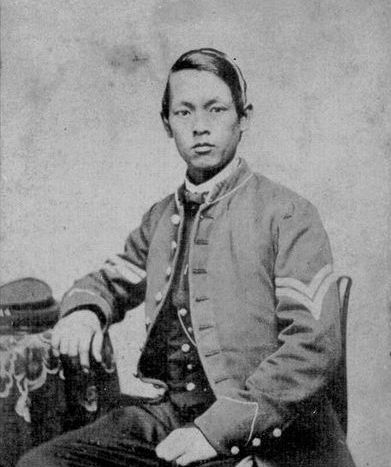
The most prominent Chinese American soldier of the Civil War, Corporal Joseph Pierce of the 14th Connecticut Volunteer Infantry Regiment, achieved the highest rank of any Chinese American to serve in the Union Army .
Born in Canton, China in 1842, Pierce was brought to the United States by Connecticut ship captain Amos Peck in the 1850s. He enlisted on July 26, 1862, and fought in pivotal battles from Antietam to Gettysburg to Lee's surrender at Appomattox Court House .
At the Battle of Gettysburg, Pierce manned a skirmish line on July 2 and volunteered for the attack on Bliss farm on July 3. He helped repulse Pickett's Charge on Cemetery Ridge, firing so rapidly that "the barrels became too hot to use" . Promoted to corporal on November 1, 1863, he participated in the Grand Review of the Armies in Washington when the Civil War ended in 1865 .
Pierce's picture now hangs in the Gettysburg Museum, and in 2007, the U.S. House of Representatives passed a resolution honoring his actions and those of other Asian-Pacific Islander soldiers of the Civil War .
Thomas Sylvanus (Ah Yee Way)
In her book Chinese Yankee: A True Story from the U.S. Civil War, historian Ruthanne Lum McCunn chronicles the story of Thomas Sylvanus, born in Hong Kong, brought to the U.S. as an orphan and enslaved in Baltimore in the mid-1850s. Despite being partially blinded in his first battle, he reenlisted twice, rescued his regimental colors at Spotsylvania, and survived 9 months imprisonment at Andersonville. His 1891 New York Times obituary called his a "singular career" .
Edward Day Cohota
Born in Shanghai and "adopted" by the captain of the merchant ship Cohota, Edward Day Cohota served in the 23rd Massachusetts Infantry during the Civil War. After the war, he rejoined the Army and served for 30 years. Cohota believed he was a U.S. citizen by virtue of having served in the Union Army, but his service had not automatically conferred citizenship upon him, and the passing of the Chinese Exclusion Act in 1882 kept him from becoming a naturalized citizen. He died in 1935, following an unsuccessful decades-long battle for citizenship .
Hong Neok Woo
Hong Neok Woo immigrated from China to Lancaster, Pennsylvania in 1855 and became a naturalized American citizen in 1860. When the Army of Northern Virginia invaded Pennsylvania in the summer of 1863, Woo enlisted as a private in Co. I, 50th Regiment Pennsylvania Volunteer Emergency Militia. His unit was deployed in Harrisburg and Chambersburg and performed picket duty near Williamsport, Maryland before being mustered out on August 15, 1863. He returned to China in 1864 and lived for another 55 years as a priest in Shanghai .
John Tommy
John Tommy, a private in Co. D of the 70th New York Infantry (part of the famed "Excelsior Brigade"), enlisted in the Army of the Potomac in 1861 and was twice captured during the Peninsula Campaign. According to the New York Times, when Tommy was brought as a prisoner before Confederate Maj. Gen. John Magruder, the general asked if he was "a mulatto, Indian, or what?" After being exchanged, Tommy was promoted to corporal and participated in the battles of Fredericksburg and Chancellorsville before being killed in action at Gettysburg on July 2, 1863 .
Christopher and Stephen Bunker
At least two soldiers of Chinese descent fought for the Confederacy. Christopher and Stephen Bunker, cousins and members of the 37th Virginia Cavalry Battalion, were the sons of conjoined twins Chang and Eng Bunker, who traveled with P.T. Barnum before marrying two White sisters and settling on a slave plantation in North Carolina. Under Brig. Gen. John McCausland,
Christopher participated in the burning of Chambersburg, Pennsylvania on July 30, 1864. He was wounded by Union cavalry one week later and spent the rest of the war imprisoned in Camp Chase near Columbus, Ohio .
A Legacy Denied
To complicate matters, the benefits that led many to enlist—freedom and citizenship—were not easily attained. It took Asians longer to receive their pensions from the Pension Act of 1890 than it did for their white counterparts, especially due to the limitation of having to prove their date of birth from public records, which did not exist in many Asian countries .
Additional gatekeeping hurdles included the Naturalization Act (1790) that declared only "white, free males" to be naturalized and the Chinese Exclusion Act (1882) that denied Chinese workers the right of entry into the United States and specifically prohibited their naturalized citizenship .
Remembering Their Service
The 2014 National Park Service publication Asians and Pacific Islanders in the Civil War highlighted the lives of 16 Chinese Americans who served, helping to bring these forgotten veterans back into public consciousness .
As NPS Director Jonathan Jarvis noted, the enduring legacy of Asian Americans and Pacific Islanders in the Civil War is their battle for civil rights—a struggle that continued long after the last shot was fired .
These veterans, who fought for a nation that would not fully claim them as citizens, deserve to be remembered not as footnotes, but as American patriots who served with distinction in the nation's most defining conflict.
Civic Watch Media | Truth. Accountability. Public Interest.