Executive Briefing
As the Trump administration enters legally uncharted territory following the expiration of the 60-day War Powers deadline, two seemingly unrelated developments are converging in the Strait of Hormuz: a sudden reversal in foreign institutional flows into Indian equities and an escalating naval standoff that the President is now framing as a "humanitarian" mission. The connection? Global capital is betting that the White House will find a way to keep the oil lanes open without triggering a constitutional crisis—or a wider war.
I. The Financial Signal: FII Return, DII Anchor
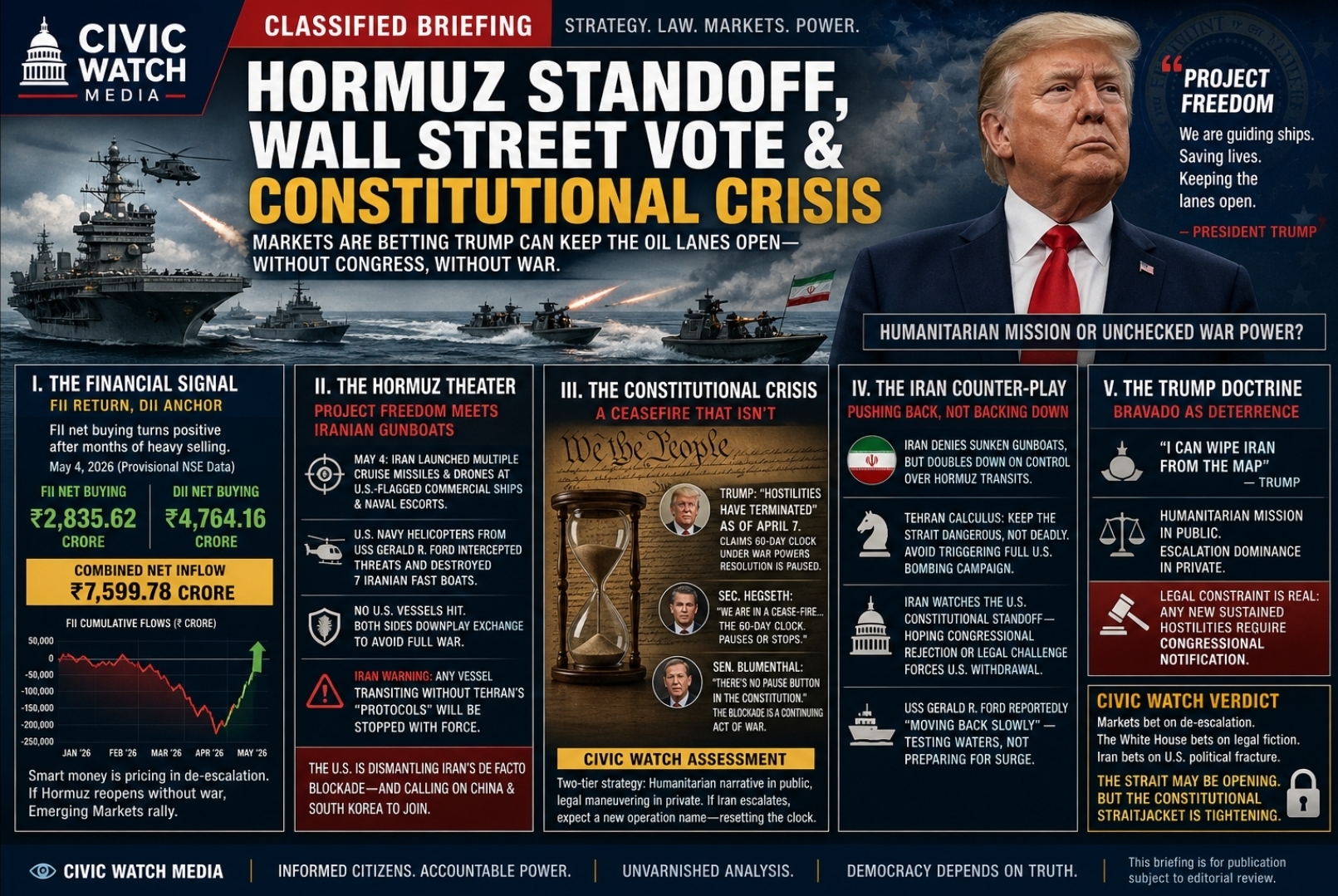
After months of relentless selling that saw Foreign Institutional Investors (FIIs) dump nearly ₹2 lakh crore from Indian markets, the tide appears to be turning. On May 4, 2026, provisional data from the NSE shows FIIs turned net buyers to the tune of ₹2,835.62 crore, while Domestic Institutional Investors (DIIs) continued their defensive accumulation with ₹4,764.16 crore in net purchases .
This synchronized buying—resulting in a combined net inflow of over ₹7,599 crore in a single session—suggests that "smart money" is repositioning for a geopolitical de-escalation. The logic is straightforward: if the Strait of Hormuz reopens without a full-blown naval war, the inflationary pressure on Asian energy importers eases, making emerging market equities attractive again. Conversely, if the standoff spirals, these same institutions will be the first to exit.
Market watchers should note: The FII turnaround comes after the May 1 War Powers deadline expired, indicating that institutional investors are pricing in a scenario where the White House circumvents—or simply ignores—congressional constraints.
II. The Hormuz Theater: "Project Freedom" Meets Iranian Gunboats
President Trump announced Monday that U.S. Navy warships would begin guiding commercial vessels through the Strait of Hormuz, a mission he branded "Project Freedom" . The administration frames this as a humanitarian effort to free stranded merchant crews running low on food and supplies. In reality, it is a direct challenge to Iran's month-long chokehold on the critical waterway.
The response was immediate. According to U.S. Central Command, Iran launched multiple cruise missiles and drones at U.S.-flagged commercial ships and their naval escorts on May 4. Attack helicopters from the USS Gerald R. Ford carrier strike group intercepted the aerial threats and destroyed seven small Iranian fast boats . No U.S. vessels were hit, and both sides appear to be downplaying the exchange to avoid triggering a full collapse of the fragile ceasefire.
Iran's Revolutionary Guard has issued a blunt warning: any vessel transiting without Tehran's "protocols" will be "stopped with force" .
The Strategic Reality: The U.S. is not merely escorting ships; it is actively dismantling Iran's de facto blockade. The White House has also reportedly called on China and South Korea—major energy importers with vessels stuck in the Gulf—to support the effort, transforming a unilateral American operation into a multilateral freedom-of-navigation challenge.
III. The Constitutional Crisis: A Ceasefire That Isn't
Here is where the classified nature of this analysis becomes critical. May 1, 2026, marked the 60-day deadline under the 1973 War Powers Resolution for President Trump to secure congressional authorization for military operations in Iran . The President chose defiance over deference.
In letters to House Speaker Mike Johnson and Senate President Pro Tempore Chuck Grassley, Trump asserted that "hostilities have terminated" as of April 7, when a ceasefire was declared . This legal fiction—asserting that a blockade is not an act of war—allows the administration to claim the 60-day clock has paused.
Defense Secretary Pete Hegseth echoed this interpretation before the Senate Armed Services Committee, stating, "We are in a cease-fire right now, which my understanding is that the 60-day clock pauses or stops in a cease-fire" .
Constitutional scholars and Democratic lawmakers dispute this reading. Senator Richard Blumenthal noted: "There's no pause button in the Constitution, or the War Powers Act. We're at war. The blockade alone is a continuing act of war" .
The Civic Watch Assessment: The administration is executing a two-tier strategy. Tier one is the public "humanitarian" narrative—reopening Hormuz for global commerce. Tier two is the legal maneuvering to maintain a de facto state of war without congressional approval, using the ceasefire as a procedural shield. If Iran escalates significantly, expect the White House to declare a new operation—distinct from "Operation Epic Fury"—thereby resetting the War Powers clock entirely .
IV. The Iran Counter-Play: Pushing Back, Not Backing Down
Iranian state media has denied U.S. claims of sunken gunboats, while Revolutionary Guard commanders have doubled down on their threat to control Hormuz transit permissions. The regime's calculus is clear: maintain enough pressure to make the strait dangerous, but not enough to trigger a renewed American bombing campaign.
Tehran is also leveraging the constitutional standoff in Washington. Iranian diplomats understand that if the U.S. Congress formally rejects authorization, Trump would face a domestic political crisis that could force a withdrawal. The slow repositioning of the USS Gerald R. Ford—described in regional reports as "moving back slowly"—may be interpreted by Tehran as a sign that the White House is testing the waters, not preparing for a full surge.
V. The Trump Doctrine: Bravado as Deterrence
Against this backdrop, President Trump's public rhetoric has escalated dramatically. In recent remarks, he has boasted of the capacity to "wipe Iran from the map" while simultaneously insisting that his Hormuz mission is purely humanitarian. This dissonance is intentional: it keeps Tehran guessing about American red lines while reassuring domestic audiences that the U.S. retains escalation dominance.
However, the legal constraint is real. Under the War Powers Resolution, any new sustained hostilities require fresh congressional notification. The administration's workaround—claiming the ceasefire paused the clock—is untested in federal courts and faces mounting scrutiny from both Democrats and a growing faction of uneasy Republicans .
Civic Watch Verdict
We are witnessing a high-stakes convergence of constitutional law, naval strategy, and market psychology. The FII buying in India is not merely a technical rebound; it is a vote of confidence that the Hormuz crisis will resolve without a regional war. The White House is betting that it can normalize military operations without legislative approval by redefining "hostilities." And Iran is betting that it can erode American resolve through low-intensity maritime harassment.
For Civic Watch readers: Monitor the USS Gerald R. Ford's operational posture and any congressional move to invoke the War Powers Resolution's withdrawal provisions. If Speaker Johnson schedules a vote on authorization—or if Democrats file suit to enforce the 60-day limit—the market optimism reflected in today's FII data could reverse just as quickly.
The strait may be opening. But the constitutional straitjacket is tightening.
Civic Watch Media operates on the principle that informed citizens require unvarnished analysis. This classified briefing is prepared for publication subject to editorial review.