China, Russia, North Korea and Iran: Is a New Military Bloc Emerging?
CIVIC WATCH MEDIA | GEOPOLITICAL ANALYSIS
Growing Security Cooperation Raises Questions About a Possible Counterweight to NATO
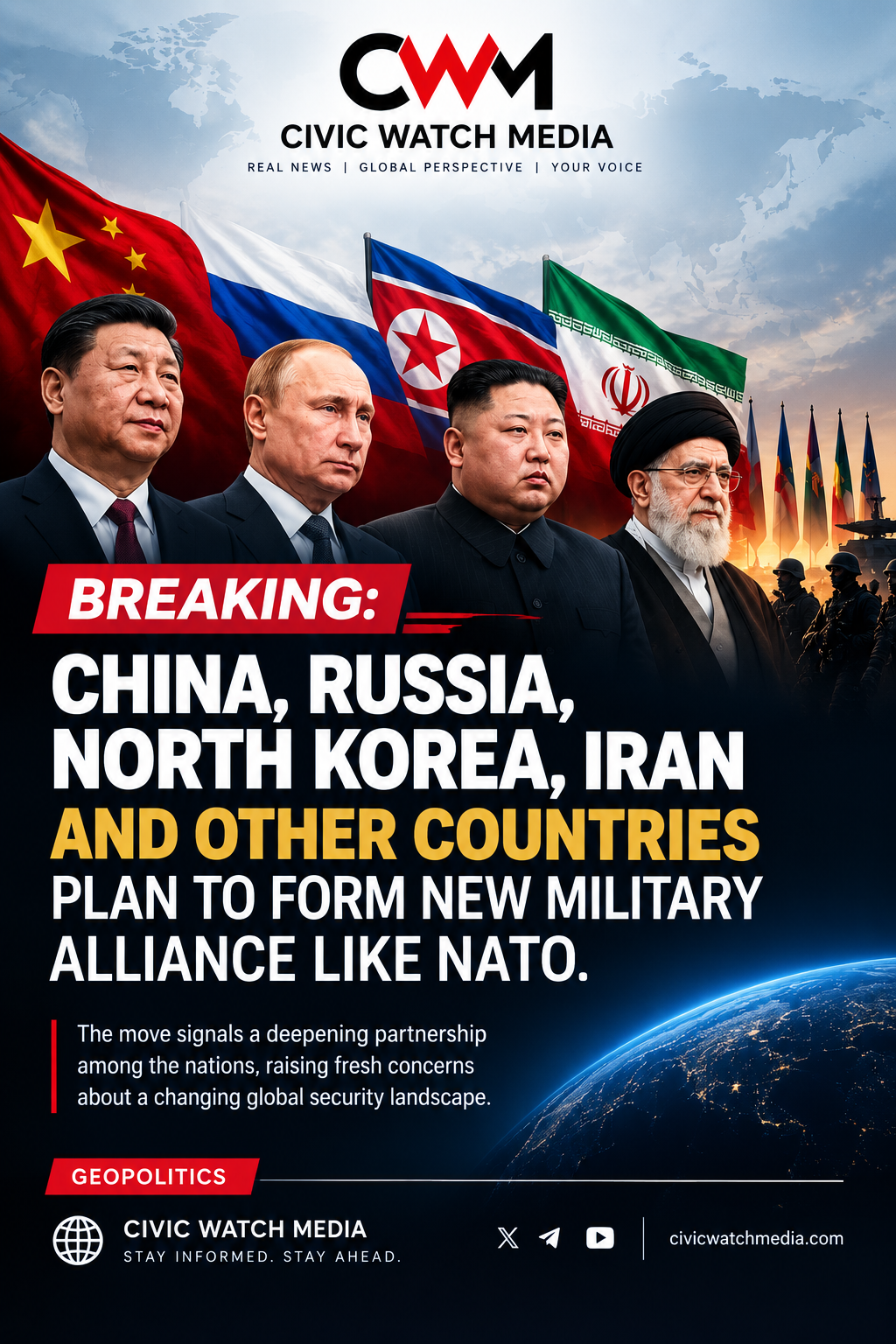
A major geopolitical question is gaining renewed attention as China, Russia, North Korea and Iran continue to deepen their strategic and military relationships: Could their growing cooperation eventually develop into a formal military alliance capable of rivaling NATO?
The four countries have increasingly been grouped by analysts under the informal label “CRINK”, reflecting their expanding security ties and shared opposition to aspects of the Western-led international order. However, claims that the countries have already agreed to establish a NATO-style military alliance should be treated cautiously.
Available evidence points instead to an expanding network of bilateral and trilateral defence relationships, military exercises, arms cooperation and strategic coordination. Analysts have noted that there is currently no established four-country command structure or NATO-style collective-defence mechanism binding China, Russia, Iran and North Korea together.
Russia and North Korea Deepen Military Partnership
Russia's relationship with North Korea has become particularly significant. Moscow and Pyongyang have strengthened their strategic partnership, while North Korea has provided substantial military support to Russia during the war in Ukraine. Russian officials have publicly described the relationship as part of a broader effort to reshape the international order.
China has also maintained close strategic ties with both Russia and North Korea. In September, Chinese President Xi Jinping and Russian President Vladimir Putin sent messages reaffirming their strategic partnerships with Pyongyang.
Iran Adds Another Strategic Dimension
Iran has also expanded defence cooperation with Russia and China. Joint military exercises and increasing strategic coordination have contributed to concerns in Western capitals about the emergence of a more interconnected network of states challenging Western influence.
The cooperation is not purely military. It also extends into energy, technology, trade, diplomatic coordination and efforts to reduce dependence on Western-controlled financial and economic systems.
At the same time, analysts caution against treating the four countries as a unified military bloc. Their strategic interests are not identical, and the relationships remain largely bilateral or limited to specific areas of cooperation.
Why NATO Is Watching Closely
NATO itself has identified the strengthening relationship between Russia, China, Iran and North Korea as a significant security concern. The alliance says Russia's strategic partnership with China, together with increasing defence-industrial cooperation involving Iran and North Korea, is changing the broader security environment.
NATO reaffirmed its collective-defence commitment under Article 5 at its July 2026 Ankara summit, while announcing major increases in defence investment and military capabilities.
A New Global Security Order?
The most important question may therefore not be whether a new “NATO of the East” already exists, but whether the expanding relationships between these states could eventually evolve into something more formal.
For now, the evidence suggests a growing strategic alignment rather than a confirmed NATO-style alliance.
But as military cooperation, defence technology exchanges, diplomatic coordination and joint exercises continue to expand, the world may be witnessing the early stages of a more divided and competitive global security environment.
Civic Watch Media will continue to monitor developments as China, Russia, Iran and North Korea reshape their strategic relationships and as global powers compete over the future of international security.