By Civic Watch Media | Sports & Culture Desk
September 11, 2026
For nearly four years, Serena Williams appeared to have closed the most competitive chapter of one of sport’s greatest careers. She had walked away from professional tennis after the 2022 U.S. Open, choosing to describe the transition not as a conventional retirement, but as an “evolution” toward family, business and other priorities.
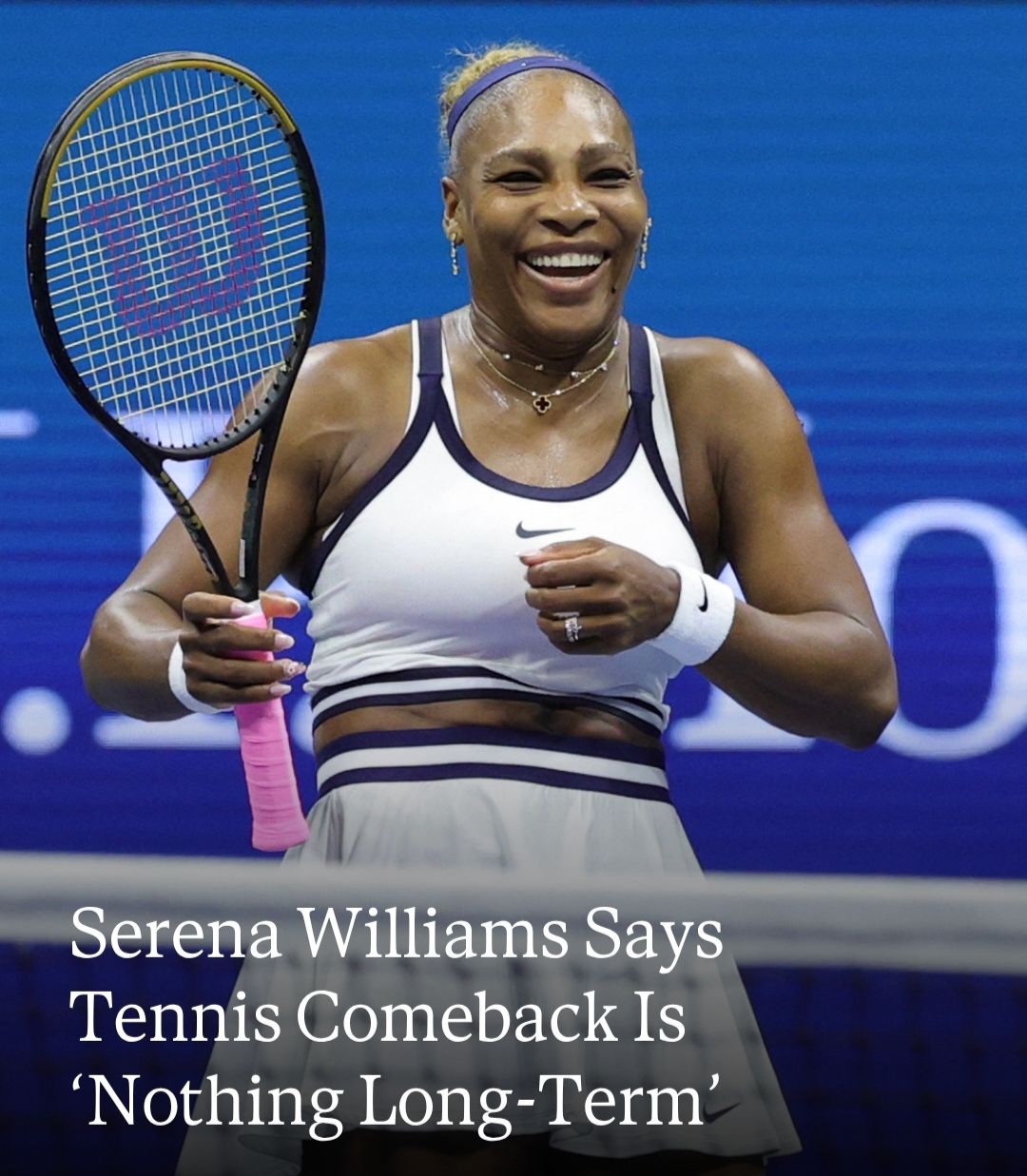
Then, unexpectedly, the 44-year-old returned.
But Williams now wants the meaning of that return to be understood differently. This is not the beginning of another long-term tennis career. It is not a campaign to rebuild a ranking, chase another Grand Slam title or prove that she can once again dominate the world’s best players.
Instead, Williams says she is back largely because she can — and because she wants to enjoy the experience while showing her daughters that a woman does not necessarily have to choose between being a mother, an entrepreneur and an athlete.
That distinction may ultimately be the most important part of Serena Williams’ latest chapter.
A return without a traditional agenda
Speaking at the Forbes Power Women’s Summit, Williams made her intentions clear: her return to tennis is “nothing long-term” and is instead about having fun.
She also spoke about the opportunity to show her daughters the woman they have heard about in books and seen represented through her extraordinary sporting legacy.
It is a strikingly different motivation from the one that defined much of Williams’ competitive career.
For decades, Serena entered tournaments with enormous expectations. Every Grand Slam became another opportunity to add to an already extraordinary record. Every opponent had to confront the possibility of facing one of the most powerful and mentally resilient players tennis has ever produced.
Now, the equation has changed.
The scoreboard still matters, but it no longer defines the experience.
Williams can step onto a tennis court without needing the result to validate her career.
That freedom may be precisely what makes this stage of her relationship with tennis so fascinating.
From “evolution” to another chapter
When Williams announced in 2022 that she was moving away from tennis, she deliberately rejected the traditional language of retirement.
In her famous Vogue essay, she explained that she preferred the idea of “evolution,” saying she was moving toward other things that mattered to her.
At the time, the decision represented a major shift.
Williams had already accumulated 23 Grand Slam singles titles, 73 singles titles overall and spent 319 weeks as the WTA world No. 1. The WTA recognizes her 23 Grand Slam singles titles as the Open Era record.
There was therefore little left for her to prove.
Her departure was about creating space for another version of herself.
That version included motherhood, entrepreneurship, investment, family and life beyond the boundaries of a tennis court.
Yet evolution, by its nature, does not necessarily mean abandoning the past.
It can mean returning to it with a different perspective.
And that appears to be what Williams is doing.
The court looks different when the pressure is gone
One of the most revealing aspects of Williams’ return has been her changed relationship with expectations.
During her original career, success was often measured through trophies, rankings and Grand Slam victories.
But during her 2026 return, Williams has repeatedly emphasized enjoyment and the uniqueness of the opportunity.
When Wimbledon offered her a singles wild card, Williams acknowledged that such opportunities are rare and suggested that she did not know whether she would ever have another chance to compete there.
That mindset is fundamentally different from the mentality of an athlete who believes she must keep competing until she reaches another particular milestone.
There is no desperation attached to this return.
There is appreciation.
Williams can now experience the court not simply as a battleground, but as a place connected to decades of memories, achievement, sacrifice and identity.
That may explain why her latest appearances have carried such emotional significance for fans.
A legendary career that already speaks for itself
Serena Williams does not need another championship to establish her place in tennis history.
Her résumé is already extraordinary.
She won 23 Grand Slam singles titles, 73 singles titles and spent 319 weeks at No. 1. She also collected Olympic gold medals and built one of the most influential careers in the history of women's sport.
Her influence extended beyond tennis.
She challenged conventional expectations about women in professional sport, transformed the commercial possibilities surrounding female athletes and became a global cultural figure.
That is why her return generated enormous attention even before she played a competitive match.
People were not simply waiting to see whether Serena could still hit a forehand.
They were watching to see what Serena Williams — the mother, entrepreneur, investor, cultural figure and sporting legend — would choose to do next.
Motherhood is now part of the story
Perhaps the most meaningful dimension of the return is the role her daughters play in it.
Williams has two daughters, Olympia and Adira, and the WTA has previously reported that one of her motivations for returning was allowing her children to see what she does firsthand.
That is a powerful reversal of perspective.
For much of Serena's career, millions of children watched her.
Now, she wants her own children to watch her.
Not necessarily because she wants them to inherit her career, but because she wants them to understand possibility.
The message is larger than tennis.
It is about demonstrating that motherhood does not automatically mean surrendering ambition, while ambition does not have to mean sacrificing family.
It is about showing her daughters that identities can coexist.
A woman can be a mother.
She can build companies.
She can invest.
She can create.
She can compete.
And she can still decide when enough is enough.
Serena's entrepreneurial life has changed the equation
The Serena Williams of 2026 is not solely an athlete.
She is also an entrepreneur and investor, including through Serena Ventures, the venture capital firm she founded.
Her life away from tennis has therefore developed into a substantial second chapter.
That matters because it changes the traditional athlete-retirement narrative.
For many athletes, retirement can mean walking away from the identity that defined their lives.
For Williams, tennis became one part of a much larger ecosystem.
She can leave the court and move into business.
She can return to the court without abandoning business.
She can spend time with her family without surrendering her competitive identity.
The boundaries are no longer rigid.
And that flexibility may be one of the most significant lessons contained within her return.
The Wimbledon comeback showed what this new Serena looks like
Williams' return to singles at Wimbledon in 2026 was particularly symbolic.
Nearly four years after her final tournament appearance at the 2022 U.S. Open, she accepted a wild card into the Wimbledon singles draw. The WTA described it as her return to singles competition after the long absence.
Her decision was not framed around an elaborate plan to rebuild a full-time career.
Instead, it was about recognizing an opportunity.
That approach was visible in the way Williams discussed the possibility of competing at Wimbledon again.
She understood that an invitation to one of the sport's most iconic stages is not something to casually ignore.
So she stepped back into the arena.
Not because she had to.
Because she wanted to.
That distinction is crucial.
Then came the Williams sisters again
The emotional dimension of Serena's return reached another level when she reunited with her older sister Venus Williams.
The sisters returned to the U.S. Open doubles court in September 2026, attracting an enormous crowd at Arthur Ashe Stadium.
Their first-round match ended in a dramatic three-set defeat against Maya Joint and Chan Hao-ching, 6-3, 6-7(6), 7-6(10-7). Despite the loss, the match became one of the tournament's most memorable spectacles. Reuters reported that approximately 23,000 fans watched the sisters' return, with the atmosphere reflecting the enormous cultural significance of their presence.
The result was almost secondary.
For spectators, this was a reunion with sporting history.
The Williams sisters had previously won 14 Grand Slam doubles titles together, while their combined singles achievements helped redefine women's tennis for an entire generation.
Their appearance at Arthur Ashe Stadium therefore represented more than another doubles match.
It was a reminder of how much their careers changed the sport.
The loss did not diminish the moment
In elite sport, defeat is usually presented as failure.
But the Williams sisters' U.S. Open defeat illustrated something different.
They lost.
Yet the stadium celebrated them.
Fans understood that they were witnessing something that could not easily be measured by the final score.
Serena and Venus were not simply competitors trying to extend a statistical record.
They were two athletes reconnecting with a part of their shared history.
The match became a celebration of longevity, family and sporting memory.
That is perhaps the clearest indication that Serena's current relationship with tennis is fundamentally different from the one she had during her championship years.
The greatest athletes eventually become larger than their results
Serena Williams' career offers an important lesson about what happens when an athlete becomes larger than the sport itself.
There was a period when Serena's value to tennis could be discussed primarily through statistics.
How many Grand Slams?
How many weeks at No. 1?
How many titles?
How many victories?
But at this point, those numbers are only part of the story.
Her influence exists in the young girls who picked up rackets after watching her.
It exists in the athletes who saw her compete unapologetically.
It exists in the conversations she forced around race, gender, motherhood, body image, professionalism and women's financial power.
It exists in the businesses she has built.
And it exists in the example she is now giving her daughters.
The tennis court is therefore no longer the entire stage.
It is simply one of several stages.
Why this return matters beyond tennis
Serena's approach challenges the idea that a career must always move in one direction.
Modern professional life increasingly involves multiple chapters.
People leave careers and return to them.
Parents redefine professional ambitions.
Entrepreneurs become athletes.
Athletes become investors.
Public figures move between industries.
Williams' story reflects that reality at an extraordinary level.
Her return says something particularly important to women who have often been pressured to choose between different aspects of identity.
Must a mother stop competing?
Must an entrepreneur abandon athletic ambition?
Must an older athlete completely disappear from competition?
Williams' answer appears to be no.
You can participate on your own terms.
You can change your priorities.
You can step away.
And, if the opportunity and desire return, you can step back in.
The difference between proving yourself and enjoying yourself
Perhaps the most profound change is psychological.
Earlier in her career, Serena had something to prove.
She had to fight expectations.
She had to overcome opponents.
She had to defend her position.
She had to chase history.
Now history has already been written.
The question is no longer:
Can Serena Williams become one of the greatest tennis players ever?
That question was answered long ago.
The question is:
What does Serena Williams want tennis to mean to her now?
Her answer appears increasingly clear.
Joy.
Family.
Experience.
Connection.
And freedom.
A legacy that does not need another trophy
There will inevitably be speculation about whether Serena might compete again.
Every time she steps onto a court, fans will wonder.
Could she play another tournament?
Could she return to another Grand Slam?
Could she partner with Venus again?
Could she surprise the tennis world one more time?
But Williams' latest comments suggest that attempting to predict a long-term schedule misses the point.
She is not presenting herself as a full-time returning professional.
She is embracing the possibility of playing when it feels right.
That means every appearance carries a certain uniqueness.
There is no guarantee of another chapter.
And perhaps that is what makes each chapter more meaningful.
Serena Williams is redefining what a comeback means
A conventional comeback is usually about restoration.
An athlete leaves, struggles back, regains form and attempts to return to previous heights.
Serena Williams' return is different.
She is not trying to become the Serena of 2015 again.
She is trying to become the Serena of 2026.
A mother.
An entrepreneur.
An investor.
A global icon.
A daughter, sister and wife.
A role model.
And, when she chooses to be, a tennis player.
That is not a return to the past.
It is an expansion of the future.
The bigger message
For Serena Williams, the most important victory may no longer be the one recorded on a scoreboard.
It may be the example being created away from it.
Her daughters can watch their mother step onto one of the world's most famous tennis courts after years away and understand that achievement does not have to end when one chapter closes.
They can see that a person can evolve without erasing who they were.
They can see that ambition can coexist with motherhood.
They can see that business and sport can coexist.
And they can see that it is possible to return to something you love without becoming trapped by it.
That may ultimately be Serena Williams' greatest message in this unexpected chapter.
She is not coming back because tennis needs Serena Williams.
Tennis already has her legacy.
She is coming back because, for now, Serena Williams wants to play.
And after everything she has given the sport, perhaps the freedom to simply enjoy the game is the most fitting privilege of all.
Civic Watch Media Perspective
Serena Williams' latest chapter should not be reduced to the question of whether she will win another major title. The more significant story is the freedom of an accomplished woman to define success beyond a single profession.
Her return demonstrates that stepping away does not have to mean disappearing, and moving forward does not require abandoning the past.
For a generation that watched Serena transform tennis, her latest journey offers another lesson: legacy is not only what you accomplish at the peak of your career — it is also how freely you choose to live after reaching it.
Sources: Forbes, WTA, U.S. Open, Reuters and other referenced reporting.